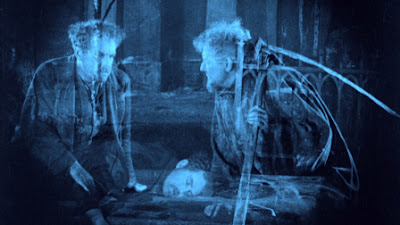
In tracing the origins of Ingmar Bergman’s screen identity back to the Swedish silent fable “The Phantom Carriage” – a movie he claimed was instrumental in his desire to become a director – one also unearths other important revelations within the frames of this puzzling endeavor. Produced and filmed in 1921 at the height of Swedish cinema’s love affair with fantasy and folklore, the movie seemed to write a language from which a future of important filmmakers would be passively influenced. Consider a sequence in which in which the conflicted anti-hero, David Holm (Sjöström), hacks down a locked door in a vain attempt to prevent his wife and children from deserting him – this harkens us immediately back to a key moment in Stanley Kubrick’s “The Shining,” when Jack Torrance does the same in a flash of psychological splintering. Other measures are equally striking: the overreaching presence of death as a puppet master directly inspired the core theme in “The Seventh Seal”; the conflicted main character’s reckless and destructive pattern would be later echoed by the likes of “Scarface” and “Taxi Driver”; and the use of redemption in the climax, especially in the face of certain mortality, would become the defining tone evoked in “It’s a Wonderful Life.”


