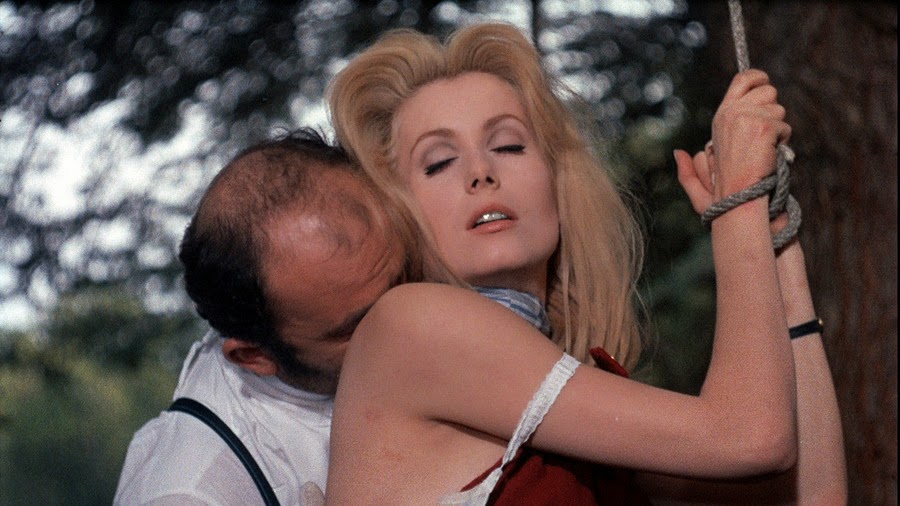
Few faces in the movies have contemporized storytelling standards as swiftly as Catherine Deneuve’s. When she is brought into the early scenes of Luis Buñuel’s “Belle de jour” – the movie that would ultimately announce her as a force of reckoning in European cinema – her expression is one of vacancy interlaced with ambiguous yearning, as if frozen in a moment of lost inspiration. Before dialogue punctuates those gazes, audiences are immediately drawn to her distinctive features; sharp and porcelain, they clearly do not assent to the same standards of early Hollywood starlets. The eyes are not glossed over by traditional values, either, but seemingly searching for something different, something forbidden. But of what, exactly? Are they paralyzed by the grind of a maddening routine? Are they stirred to discomfort by the unnerving finality of a marriage? Though incessantly voracious, her expressions do not draw obvious attention to the unrest in any of those around her, because that is part of her elaborate game. As the simple but calculatingly elusive Séverine, Deneuve creates a character that fills the space with a sense of wild destiny. She is not a pawn in a screenplay of emotional chess moves, but a firm hand moving around all the pieces in a game she slyly rewrites the rules for. Imagining her now, in a generation of female empowerment, is like witnessing the birth of a standard in the face of an accidental archetype.


