Showing posts with label EROTICISM. Show all posts

Wednesday, March 14, 2018

Fifty Shades Freed / *1/2 (2018)

Perhaps the issue is the constraint of an acceptable running time, or the attitude of a conventional outlook. Some conflicts are not meant to be easily resolved in the span of a two hour film; to do so is to gloss over the intricacies of moral gray areas, even if they may run as shallow as the intentions. Some part of me holds onto this possibility when attempting to deal, in any capacity, with the “Fifty Shades” films, and now I’m confronted with a third venture, in which characters gather to experience life after the fairy tale has ended and find themselves in the embrace of deficient dramatic throes. I guess this idea could possess enough complexity to justify a trilogy of pictures, but is there not a responsibility to anyone involved to make the best use of our commitment? If what exists on screen runs parallel to the written works of E.L. James, then here is a woman who seems incapable of modulating the human rhythm on the tightrope between eroticism and danger. Imagine spending a day in the company of people who raise legitimate doubts about their situations but never come to terms with them, essentially because they have discovered an orgasm that negates their need to contemplate troubling histories.

Sunday, September 3, 2017

Fifty Shades Darker / * (2017)

“Fifty Shades Darker” descends thoughtlessly into a web of intrigue spun with blender-like accuracy, primarily to move its characters, yet again, from one orgasm to the next with minimal interruption. More perceptive romances, even the more vulgar ones, might at least see this as a ploy to harness some level of plausible dramatic tension, however thin. But for the people behind the latest in a growing fad of seductive literary cheese aimed at the lower end of the payoff pool, it plays like a clothesline for the writers to hang their one-note fetishes on, concealing them from the greater realities of chemistry and foreplay. Is this what the concept of movie eroticism has come to? Have we finally abandoned the almost cheerful adolescence of human behavior and turned it into a cold scheme to reach climax? Centering on four primary catalysts to frame the impending affairs of Anastasia Steele and Christian Grey, the minds behind this highly-anticipated follow-up prove, if nothing else, that a lack of understanding in conflict resolution means squat when all one shows up for is the lust. After watching it I imagined Catherine Deneuve sobbing quietly in a dark room for the future of adult fantasy.

Tuesday, August 22, 2017

Basic Instinct 2 / * (2006)

Sharon Stone so persistently owns what she does on screen in “Basic Instinct 2” that one is likely to find her conviction admirable, even if she is basically a PR agent selling a defective product with a straight face. Far lesser sorts might have inspired a sympathetic gesture, but this is a woman in no need of such pity – with every wince of her stern gaze and gurgle of a monologue she sneers confidently back at the camera, as if fully aware of the punchline before her writers have formulated the joke. In some regards that allows many of her more sub-par pictures to rise above their mediocrity, if for nothing more than for the assuredness of her presence. But that also means we must test ourselves with the limits of witless screenplays and be willing to ask: how far is too far when descending into such lopsided mind games? Here is a film in which all those involved, even the ones who may be ambivalent, are contracted to enslave us in the grip of patronizing hogwash.

Wednesday, February 10, 2016

Fifty Shades of Grey / *1/2 (2015)

There is something inherently unsettling about a young handsome billionaire that spends all his time thinking about aggressive sexual desires. To witness him come to fruition in the frames of “Fifty Shades of Grey” is to partake in an intriguing case study, in which we become transfixed by the strange dichotomy of an upstanding citizen as he delves into pleasures that are as devious as they are time-consuming.  How does anyone, indeed, come to be so successful and dependable in the business world without taking a break from getting off? Christian Grey, an ego-maniac who lives and works in sterile spaces, doesn’t seem as if he has lived with any other interest beyond the possibility of luring a poor unsuspecting girl into his chamber of dark fetishes. It possesses him so incessantly that there is almost no time for business calls or important meetings – just enough to follow someone around to social jaunts or into secluded areas in order to exude erotic authority. In some strange paradoxical way, the poor subject of these actions finds them endearing, almost romantic. But who in any self-respecting audience is going to share in that perception without feeling uneasy? In a story with a tone this uncertain, Christian plays less like a Casanova with conviction and more like a brute eager to replace Patrick Bateman on the creepy meter.

Friday, August 29, 2014

Lessons from Criterion:
"Belle de jour" by Luis Buñuel

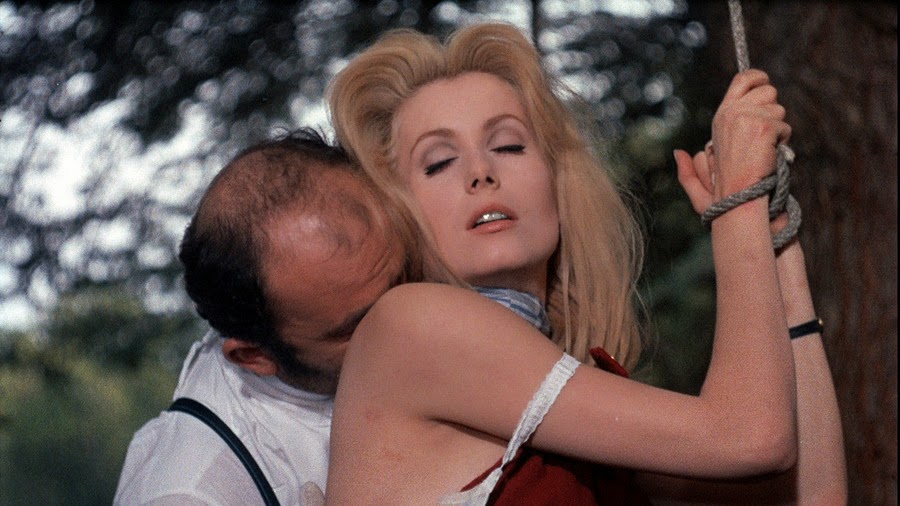
Few faces in the movies have contemporized storytelling standards as swiftly as Catherine Deneuve’s. When she is brought into the early scenes of Luis Buñuel’s “Belle de jour” – the movie that would ultimately announce her as a force of reckoning in European cinema – her expression is one of vacancy interlaced with ambiguous yearning, as if frozen in a moment of lost inspiration. Before dialogue punctuates those gazes, audiences are immediately drawn to her distinctive features; sharp and porcelain, they clearly do not assent to the same standards of early Hollywood starlets. The eyes are not glossed over by traditional values, either, but seemingly searching for something different, something forbidden. But of what, exactly? Are they paralyzed by the grind of a maddening routine? Are they stirred to discomfort by the unnerving finality of a marriage? Though incessantly voracious, her expressions do not draw obvious attention to the unrest in any of those around her, because that is part of her elaborate game. As the simple but calculatingly elusive Séverine, Deneuve creates a character that fills the space with a sense of wild destiny. She is not a pawn in a screenplay of emotional chess moves, but a firm hand moving around all the pieces in a game she slyly rewrites the rules for. Imagining her now, in a generation of female empowerment, is like witnessing the birth of a standard in the face of an accidental archetype.