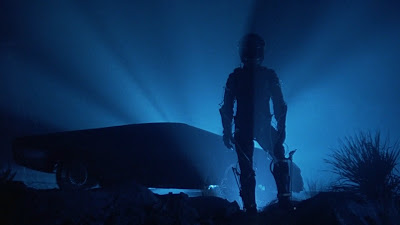
In the annals of absurd action films that dominated the public’s awareness during the 80s, “The Wraith” may hold special distinction as the silliest of them all. How else would one describe the very idea of this film? Could it be done with a straight face, or some semblance of seriousness? Here is a premise that seems as if it were pulled right out of farce: a gang of car thieves murder a man, and then said victim is reincarnated from above so that he can exact his revenge by, well, racing them all to their deaths inside a mysterious black car. But wait, it gets better: when he is not inside said vehicle, he appears as an enigmatic drifter played by Charlie Sheen, who comes into town and interacts will all the same people who were once part of his previous life, including those who killed him. How do they not recognize him? Because, rather conveniently, his face has been changed. Furthermore, none of those observers suspect who he really is, although chance encounters eventually create enough of a sense of déjà vu to inspire all the obligatory inquiries (“have we met before?”). If you’re still paying attention, congratulate yourself: you may have actually thought more thoroughly about this setup than Mike Marvin, whose screenplay might as well have been assembled out of remnants of shorthand notes from an etch-a-sketch.
Showing posts with label 1986. Show all posts
Sunday, May 31, 2020
Wednesday, November 18, 2015
Ruthless People / ***1/2 (1986)
The gift of perverse curiosity was the tool from which a broad supply of ‘80s entertainments acquired their creative wings, and “Ruthless People,” about a kidnapping gone completely bonkers, is one of the unspoken benchmarks of that notion. So little of the movie is actively recognized in today’s conversations about the good old days of film slapstick, but in recognizing its core values in modern contexts, we discover many of the critical origins of what can now be looked at as dark comedy. That’s because unlike the movies of the time, it was a picture that reached far beyond the thrust of mere misunderstandings or embarrassing situations, and actively involved us in the lives of unpleasant sorts who created havoc and had to, rightfully, endure their disruptive (and often hilarious) consequences. But what nerve did we have finding any of it funny, much less watchable? It’s because the screenplay implored the use of individuals who could handle their plight with savage responses, and maintained a certain sense of shrewd likeability even as the world around them was collapsing in an ambitious display of illegal trickery. No person who saw it all those years ago could deny it contained some audacious and gargantuan laughs, and few today would be able to make it through without at least volunteering a few lighthearted chuckles, even in the face of immense modern desensitization.
Sunday, October 11, 2015
Henry: Portrait of a Serial Killer / ***1/2 (1986)
The bone-chilling opening scenes of “Henry: Portrait of a Serial Killer” carry a very ominous subtext: several of them replicate actual crime scene findings of real-life homicide. In their presentation is a pattern that amplifies their findings to the pinnacle of unnerving reactions; the camera cautiously swerves into view of deceased victims frozen in poses of terrible death, and the speakers vibrate with the muffled sounds of their final moments, most of which include horrific screaming as they are violently attacked and murdered. They are not necessarily related to one another, but a common bond does unite them – namely, they are victims of the same man, a creature of corrupt morality who must feed on the power of other’s fading life essences. What drives men like him to the brink of that urge? That is always the question, it seems, in a genre that must consider the antagonists directly. Some do so because their internal suffering has made it their only satisfying outlet. For a rugged loner like Henry, the notion of causing death seems merely to be an act of passing time in an existence that slogs along without purpose or joy.
Tuesday, May 26, 2015
Poltergeist II: The Other Side / ** (1986)
The family at the heart of the original “Poltergeist” lost more than their sense of security in the wake of their encounters with vengeful spirits – they also misplaced a few brain cells along the way. There is a scene in the sequel that demonstrates such prospects with disheartening clarity; in it, the young son Robbie (Oliver Robins) is attacked by unseen forces in an upstairs bathroom, and the metal from his braces expands in a violent attempt to cocoon him. Audiences immediately recognize this ambush as a decoy, replicating the sensibilities of an earlier attack by an evil tree in the front yard of the first movie: it occurs not because the poltergeist is after him specifically, but because it needs to distract the parents in order to get closer to Carol Anne (Heather O’Rourke), who is their primary target. The virtue is that a Native American named Taylor (Will Sampson), assigned to watch over the family, is there to hold onto her while the others flee to the aid of their endangered son. But in the wake of his rescue, there is an angry outburst from the father (played with over-the-top gusto by Craig T. Nelson) in which he accuses Taylor of refusing to help in a critical moment. Did he forget that his frightened young daughter was snatched away the last time she was left alone, and probably needed the protection more? At the height of fear, one of our most easily lost qualities is the ability to perceive what might keep us safe. For the Freeling parents, one wonders if their experiences have simply rendered them mentally incapacitated.
Tuesday, October 15, 2013
Aliens / ***1/2 (1986)
Think of the calculated patience of the Ellen Ripley persona. Here is a woman whose level-headed approach armed her with a foresight that would have allowed all those involved in the “Alien” movies to circumvent confrontations with menacing bloodthirsty monsters, had she not been surrounded by those too lazy or corrupt to follow rules. It was she who anticipated dread when those aboard the Nostromo decided to answer an ambiguous alien distress signal on a remote planet. It was she who refused to open the ship’s hatch when it became obvious that one of her comrades had been exposed to a face-hugging parasite. It was she who expressed discontent over others placing themselves in uncertain danger, even though it may have made her seem unsympathetic in the minds of emotional crew members. It was she who dug deep enough to discover that her crew’s resident android had been programmed to bring the alien life form back to Earth regardless of the safety of others. And when the creature gradually began picking crewmembers off in the shadowy corridors, it was she who stayed focused and committed to the cause of survival, despite the fact that the encounter caused the deaths of all those around her (save for a feline named Jones).
Thursday, September 26, 2013
Stand by Me / **** (1986)
When you are an adventure-seeker stuck in that odd transition between early youth and adolescence, few movies resonate more than “Stand by Me.” Our suspicions suggest all the right notes are found not so much on the basis of having gifted filmmakers telling this story, but in the implication that its ideas come from within a collective experience that all men recall with some fondness (or alarm) as they grow older. Rob Reiner, Stephen King and Bruce Evans often find this trait meandering through many of their endeavors, and it’s a wonder they even bother referring to some of those stories as works of fiction. Together, they seem destined to write the prototype for what nearly all male youths will endure on their journey towards a more informed state of wisdom, and here it is all told in a setting where a quiet community is altered by fate’s own sleight of hand, and four spirited individuals are challenged by an event that will compel them to grow up much sooner than they should.
Subscribe to:
Posts (Atom)


