Showing posts with label *1/2. Show all posts

Tuesday, October 8, 2019

Joker / *1/2 (2019)

Long before mental health awareness pigeonholed the Joker personality as a damaged loser prodding psychological wounds, Bob Kane’s villain existed somewhere between the cynical and the sardonic, like an instrument of showy destruction joyously sticking a thorn into the sides of his opposition. If the early comic book readers never quite saw him as a great monster, it’s because the material was emboldened by the irony of the façade; the clown makeup and the ridiculous cackle were behaviors of cartoon personalities rather than straight madmen. But now we have crossed into the space where graphic yarns have lost that distinction and have become living embodiments of the terror within. With that the villains of Gotham City have gone through a considerable transformation, starting with the Tim Burton “Batman” films, where criminal minds were founded by childhood trauma rather than a simple need to be devious. Christopher Nolan’s adaptations took this prospect even further; gone were the absurdist production designs, and in their place were tangible forces of darkness that seemed as if they were walking past us on any ordinary city street. The most profound modern realization of the Joker belonged to “The Dark Knight,” where Heath Ledger took the idea beyond the source’s own possibility and showed us a broken personality whose chaotic tendencies were like a roadmap leading back to a mind wrought with personal hell. Alas, now we must contend with Todd Phillips’s miserable “Joker,” about a man who knows no humor, slogs through a world riddled in corruption and limitation, and finds escape in unleashing the sort of gratuity and destruction usually reserved for cynical horror films.

Wednesday, June 19, 2019

Dark Phoenix / *1/2 (2019)

It takes a certain endurance to thrive among the X-Men, especially in the movies. Reflect for a moment on how frequently this team of misfits changes lineup: one minute a certain character is front and center, joining the ranks of Xavier’s mutants as their power comes to fruition, and then the next they are cast as a backdrop when someone more exciting (or dangerous) comes strolling through the doors, like new car models or better generations of cellphones. Only the more showy or idiosyncratic personalities ever make it past this curse of a momentary observation, and as with the source material the film adaptations have often leaned towards the same series of faces to revolve around: Wolverine (who even starred in his own trilogy of movies), Magneto (the most consistent villain), and Mystique (who has the benefit of, well, always being able to change her appearance). Now the filmmakers can add poor Jean Grey to that list of primary identities, if for no other reason than because of what her history will dictate: that she will go beyond being a normal telepath and see her mutant abilities ascend into the realms of gods and monsters. The newest chapter of this series, “Dark Phoenix,” has the distinction of casting her in that role before she is emotionally developed, which adds another challenge: how do you control yourself in a situation where everyone in the room has either lied to you or knows you must be destroyed to preserve humanity?

Tuesday, January 8, 2019

Twilight / *1/2 (2008)

Vampires rarely require the companionship of fearless dupes to function as predators, but it certainly changes up the monotony of an exhausting routine. Luckily for one featured in “Twilight,” he makes the company of a teenage girl who audaciously regards him as an equal. Maybe that’s part of what cripples the movie surrounding them: it misconstrues the dynamic that is otherwise fundamental. These are not unions established by conflicted beasts and ambivalent humans, but by souls who find that their alienation is one helluva common interest to flirt over. Sometimes, they even share in the same sense of hormonal desire – hers new and emerging, his apparently immune to hundreds of years of undeath. They circle around the point until there is no way to avoid the inevitable: their awkward exchanges and forceful outbursts are a mechanism standing in for eventual foreplay. That might have worked in a film that had any sense of what characters were about beyond their need to touch the forbidden, but like most great psychological lessons in the hands of novices, this is a story far more interested in dancing to rhythms than understanding melody.

Tuesday, December 18, 2018

Home Alone 2: Lost in New York / *1/2 (1992)

Did the characters of “Home Alone” survive the ordeal of the original film, or could they have slipped into an alternate timeline before cameras showed up for the sequel? This is one of many questions worth mulling over as the events of “Home Alone 2: Lost in New York” play out in all their absurd glory, right down to a shameless and patronizing third act, which even contains a scene where young Kevin McCallister (Macaulay Culkin) tries to lecture a homeless woman on living in fear of a broken heart. Where does he get the nerve? Perhaps he was empowered by enduring through the climax of the first film, where he outsmarted two burglars with comic savagery. Maybe surviving alone, stranded from his family, gave him pause to recognize his own fierce independence. Maybe being on the streets of Manhattan have hardened his edge. Or most likely he has just become the victim of writing that has lost its grip on any form of tangible reality. This is not a hard possibility to assume, after all, particularly when you consider everything that leads to that point. Here is a film where the adults lack common logic, parents are deluded to think they have a shred of credibility, and situations are contrived for the purpose of a cartoonish agenda that moves from one ridiculous moment to the next without any substantial point. Whatever merits we attach to the first film in this series, they are all but abandoned somewhere in the mess of a follow-up.

Wednesday, November 14, 2018

The Grinch / *1/2 (2018)

Some realities are a given without being vocalized. To explain what otherwise ought to be common is to unravel the momentum of a good observer. Think of Dr. Seuss’ immortal yarn about the Grinch, for instance. Was it ever in doubt to the average reader – even a novice one – that the villainous ways of the furry green disruptor were not sourced from an internal trauma? Or that his envy, his thorough dislike of the holiday, could not be understood unless it involved some form of relentless exposition? Our youthful minds simply accepted his agenda for what it was: a gloomy impulse to cloak a fear lurking beneath a gruff exterior. Any doubts were clarified, quite literally, with a climax that broke away his cynicism. That’s because Seuss knew the power of the young mind well enough to not insult it with the burden of excess. But now his beloved creation comes to the hands of filmmakers who have lost sight of the nuance, the shrewd irony, of one of the great holiday lessons. “The Grinch,” a new CGI cartoon that adds a fair amount of insights, is the concoction of overpaid simpletons who have opted for a more literal subtext and undermined the very spirit of the source in the process.

Wednesday, March 14, 2018

Fifty Shades Freed / *1/2 (2018)

Perhaps the issue is the constraint of an acceptable running time, or the attitude of a conventional outlook. Some conflicts are not meant to be easily resolved in the span of a two hour film; to do so is to gloss over the intricacies of moral gray areas, even if they may run as shallow as the intentions. Some part of me holds onto this possibility when attempting to deal, in any capacity, with the “Fifty Shades” films, and now I’m confronted with a third venture, in which characters gather to experience life after the fairy tale has ended and find themselves in the embrace of deficient dramatic throes. I guess this idea could possess enough complexity to justify a trilogy of pictures, but is there not a responsibility to anyone involved to make the best use of our commitment? If what exists on screen runs parallel to the written works of E.L. James, then here is a woman who seems incapable of modulating the human rhythm on the tightrope between eroticism and danger. Imagine spending a day in the company of people who raise legitimate doubts about their situations but never come to terms with them, essentially because they have discovered an orgasm that negates their need to contemplate troubling histories.

Monday, November 6, 2017

The Belko Experiment / *1/2 (2016)

I may be going out on a limb when I suggest that “The Belko Experiment” has been manufactured by motivated filmmakers. Clearly molded in the image of the recent “Purge” series – where the scares are brought on by social and political unrests – here is a film that so agonizes over the effort to marry its violent nature with discussion-worthy contexts that there is little reason to contemplate skepticism. Someone high up, be it Greg McLean (the director) or James Gunn (the writer), was tapping into the most pointed trend of the times. But if I was paying attention to, say, a random soliloquy in one of the great Shakespeare tragedies, does that also mean I’m a fluent practitioner of the language? Can I turn around and recite the famous words of Hamlet while understanding the metaphorical nuance behind the conviction? A horror movie may not be in the same league as Shakespeare, of course, but there’s just about as much divide between those comparisons as there is between the concept of this movie and reality of those it imitates. A greater genre endeavor about the political ramifications of its terror will drive the point down to the guts of an issue, leaving one to contemplate the argument as their senses recover from an assault. What goes on in the frames of this film plays like an understanding of procedure but nothing of soul.

Friday, October 20, 2017

Sleepaway Camp / *1/2 (1983)

Of a plethora of tenacious relics that persist with some level of notoriety in the dead teenager formula, few have been as puzzling (or as maddening) as Robert Hiltzik’s “Sleepaway Camp.” Cut from the same blood-soaked cloth that gave birth to the “Friday the 13th” and “Prom Night” franchises, here was a picture heralded in the margins of filmgoing as an audacious blend of macabre visuals and social underpinnings, inevitably casting it in a light that far exceeded the expectations of its class. Others were content to regard it as harmless (if violent) fun, and those sorts might have been the first to develop long-term hindsight; better films would eventually come along to inform their palettes and diminish the lesser pleasures. But like an open wound with a relentless sting we are forced to consider this thing in the sweep of horror film history even now, despite that far more ambitious movies have drifted deeply into the annals of cinematic myth and legend. Its strange endurance, at best, emphasizes the dichotomous standards of the populists, who usually sneer in protest at a standard that freely robs the ideas of the masters while displacing their tonal conviction.

Monday, May 8, 2017

The Mist / *1/2 (2007)

Movies anchored in deep mysteries depend just as much on their endings as they do a gradual momentum of tension, otherwise cynical audiences begin to question the motives of their filmmakers. Getting caught up in the thrill of a chase or the grind of an ambiguous device comes with a certain amount of excitement, certainly, but rarely does one walk away satisfied if it is all used to a point that undermines the experience of jumping during the key moments. Something, perhaps, about an inconclusive explanation (or worse yet, a ridiculous one) undercuts the meaning of having a good time, even for something as innocent as a Saturday popcorn matinee. Take Frank Darabont’s “The Mist” as a prime example. Here is a film pitched at a median aesthetic, made with competence and skill, and played by actors who seem to be far above the roster normally attracted by such stories. By all measures we should be eating an opportunity like this up with great enthusiasm. But the last 30 minutes play like a dismissive ambush, leading to a final scene so utterly misguided that I wanted to hurl obscenities at the screen.

Wednesday, February 8, 2017

The Vatican Tapes / *1/2 (2015)

When it comes to supernatural dangers, a priest to the movies is what black cats are to superstitious amblers – a presence that should to be avoided at all costs, lest they lure you into the hungry jaws of pain and suffering. A certain awareness of this possibility rises to prominence in the early scenes of “The Vatican Tapes,” in which Father Lozano (Michael Pena) is seen casually brushing past an injured woman arriving at the hospital. Their dialogue is brief and innocuous, but necessitated; it implicates their relationship as one of destiny, to be escalated shortly thereafter when said woman begins to show signs of a dangerous pathological state. Yet just as precise the foreshadowing is, one can’t help but wonder if it all comes off as excessively ham-handed, even for a film of this nature. Certainly we know what we are in for right from the beginning as opening credits roll, in which a montage of footage of exorcisms is seen flashing between title cards. Certainly the early discussions of priests warning each other of demonic forces are enough to implicate a source. And certainly the abrupt transition of the heroine’s charming demeanor to one of misery is enough to lead one down all the obligatory psychological and moral detours of demonic possession premises. Observing these devices in all their vulgar and excessive glory made me nostalgic for the subtlety of “The Exorcist,” a film that outlasted all others because it trusted the audience to assemble the mystery in the slow passages.

Sunday, October 30, 2016

Trick 'R Treat / *1/2 (2007)

The opening scene of “Trick ‘R Treat” shows a married couple arriving home at the end of a long Halloween celebration in the hopes of settling into less glamorous routines. The husband ventures upstairs and turns on pornography; the wife, eager to remove the decorations littering her front yard, begins the arduous process of dismantling elaborate displays of fake limbs and ghostly figures. A dialogue exchange acts as a shallow warning against the practice; he suggests blowing out the candle on the pumpkin by the gate violates the code of the holiday, which must be followed by fatal consequences. Shortly before she is murdered and disfigured by a figure hiding beneath bed sheets on the lawn, there is a moment where she stops to proclaim, without regret, that she “hates Halloween.” After a few short minutes into the bad movie she is trapped in, we can understand why; to be lost in the meandering chaos of a night like this with little to define the terror itself is a fate worse than any scares that might exist in the shadows. For the audience, the true horror is that anyone involved thinks they are pitching these curve balls for some great purpose.

Sunday, October 9, 2016

Madman / *1/2 (1981)

The unpleasant, dreary and humorless “Madman” is frequently cited among a handful of early 80s slashers as a genre standard, but it operates on one level that seems lost among its most loyal admirers: as a workshop for Darwinian selection. It was the great naturalist who first suggested the human race was the byproduct of centuries of inherent culling – that over time, a species was destined to conform to the environment it lived in while the inferior genetics would simply be forced to die out. One can argue a horror movie buried in the framework of the dead teenager standard always plays right into this theory, but rarely has it been so obvious, or indeed as unfortunate, as what filmmakers freely put on display here. The characters that populate the foreground of Joe Giannone’s film are suspiciously stupid, even by the measuring stick of his own premise. They barely function as humans, seeming lost in a haze of thoughts that are mechanical and uninformed. Their faces are frozen in confusion. They engage one another like they have no sense of individualism. Their dialogue is forced beyond comprehension, as if assembled by frequent trips down the greeting cards aisle of the Hallmark store. And that of course means they will be ill-prepared when they are required to react during a confrontation with a local legend, a deceased farmer who has returned to form to do away, I guess, with anyone that wanders into the woods he used to live in. Is he a maniac at all, or merely a soldier for evolution?

Tuesday, June 14, 2016

Warcraft / *1/2 (2016)

A great many brush strokes of creative dexterity have gone into building the universe of Blizzard’s treasured Warcraft saga, but few of them ever rise to the surface in the first live action movie about the popular game series. How do I know that’s the case? Because I, dear reader, have been an avid player (and reader) of the notorious PC phenomenon for nine years – indeed a treasured pastime that has ebbed and flowed with consistent prominence nearly as much as going to the movies has in recent times. Never one to be loyal to a hobby for longer than a few entertaining months, however, the ongoing hold of “Warcraft” is as bewildering to me as it might be to those unaware of my personal pleasures. It persists like a story you play with in your mind. And that is not an isolated feeling, otherwise the necessity to take the concept into the footholds of cinematic interpretation would have never gone this far. Couple that with the dueling perspectives of video game-to-film trends (seldom successful and usually disastrous) and a reputable director standing at the helm (Duncan Jones, the master behind “Moon”), and what arrives in theaters isn’t so much a standard action flick as it is a predestined clash between cinema enthusiasts and players of the game, both of whom will no doubt be measuring the final result with entirely different gauges.

Wednesday, April 6, 2016

Batman v Superman: Dawn of Justice / *1/2 (2016)

Jesse Eisenberg has a kind of obstinate charm that is equal parts zany and startling, and in many of his roles there is a sense that he's driven by some facet of self-arrogance, as if overly cognizant of the fact that his characters are the smartest ones in the room. Usually that means his personas can also come across as unhinged beyond comprehension, especially when they face tremendous obstacles; to see him chew through the conflicts of a screenplay is to make rather unflattering assessments of the tactics he implores, which frequently involve vindictively untethering the routines of more modulated sorts. There is no doubt that his endeavors in “The Social Network” and “Now You See Me” were reason enough to see him as an apropos choice for the daunting role of Lex Luthor – they seemed destined to one another, like a man visiting the altar of his own creation. And yet so thorough are his capabilities that one finds them soiled when they are taking into the context of the movie that surrounds him with few interesting things to do, as is the case with his newest foray. Unfortunately, that also means poor Eisenberg has to overextend his creative pitch in order to sell the characterization; by the end, one gathers he has accepted the material as a humongous joke, with him being the only one in on the punchline.

Wednesday, February 10, 2016

Fifty Shades of Grey / *1/2 (2015)

There is something inherently unsettling about a young handsome billionaire that spends all his time thinking about aggressive sexual desires. To witness him come to fruition in the frames of “Fifty Shades of Grey” is to partake in an intriguing case study, in which we become transfixed by the strange dichotomy of an upstanding citizen as he delves into pleasures that are as devious as they are time-consuming.  How does anyone, indeed, come to be so successful and dependable in the business world without taking a break from getting off? Christian Grey, an ego-maniac who lives and works in sterile spaces, doesn’t seem as if he has lived with any other interest beyond the possibility of luring a poor unsuspecting girl into his chamber of dark fetishes. It possesses him so incessantly that there is almost no time for business calls or important meetings – just enough to follow someone around to social jaunts or into secluded areas in order to exude erotic authority. In some strange paradoxical way, the poor subject of these actions finds them endearing, almost romantic. But who in any self-respecting audience is going to share in that perception without feeling uneasy? In a story with a tone this uncertain, Christian plays less like a Casanova with conviction and more like a brute eager to replace Patrick Bateman on the creepy meter.

Sunday, December 6, 2015

Horrible Bosses / *1/2 (2011)

“Horrible Bosses” begins with a smart premise about a group of friends exacting revenge on a slew of corrupt professional supervisors, and then slowly but gradually descends into the meandering embrace of excess, stupidity and tragic comic timing. By this point, you recognize the trend more than you should: it has almost become customary in movies like this for friends who are down on their luck to get involved in some kind of conflict that causes them to react with eccentric flair (not to mention dialogue that could be uttered by any simpleton standing in line at a convenience store). What provokes filmmakers to still find those generic quirks amusing is its own issue – but why did actors like Jason Bateman, Colin Farrell and Kevin Spacey, so clearly in a league of their own, agree to partake in such a shoddy exercise of those qualities? Did story conferences leave anyone optimistic that they were dealing with material that was funny, or did they just assume that the charisma of their co-stars would be enough to offset the reality that the jokes were trying way too hard?

Thursday, October 15, 2015

Insidious: Chapter 2 / *1/2 (2013)

A shameless cliffhanger is the biggest disservice a film can offer to a prospective sequel, and that’s exactly what happens to the foundation of the whacky “Insidious: Chapter 2.” You remember the situation well, I’m sure: at the conclusion of the prior endeavor, a key character in the urgent rescue of a young boy was (potentially) possessed by a restless malevolent spirit, resulting in the tragic death of a critical asset to the supernatural fight. When its identity was implied via a picture taken on a digital camera, the screen faded to black and left us with the essential focus question: what happened to all those who are now stuck with a menacing monster? The director, James Wan, is used to that gimmick; after helming the first “Saw” installments – which prided themselves on such last-ditch trickery in order to propel interest through a slog of sequels – he has grown accustomed to the notion of saving the biggest reveal for the final moments. That is acceptable in a series that uses the ploy to audience expectation, but it doesn’t work here, and what both he and his writer have done is given us a follow-up that doesn’t play so much as an isolated story as it does an extended climax.

Tuesday, July 28, 2015

Pixels / *1/2 (2015)

Though it ought to have inspired something tremendously amusing, “Pixels” functions like a rally of egos down at the story conference workshop.  A hypothetical image begins to formulate in our heads very early on, in which a gathering of middle-aged comedians come together, wax nostalgia over the forgotten innocence of ‘80s boy culture, and then share in a moment where their love of old arcade games bonds them. In a moment that must have transpired like most spastic nerd fantasia of its kind, you can predict the ensuing dialogue: “What if characters in a movie sent a time capsule of those games up into space, and it was discovered by aliens who perceived it as a threat instead of a gift? Surely there’s an idea for a movie here somewhere!” Roughly one out of ten people in a focus group would respond to that premise with some level of colorful enthusiasm, while the rest of us would, I’m sure, solve the problem entirely by asking one rebuttal question: “why don’t we just go play the old video games again instead of subjecting them to something completely absurd?”

Saturday, May 23, 2015

Poltergeist / *1/2 (2015)

Every suburban household, they say, shelters a conflict threatening to unravel the strength of the family unit. The characters in “Poltergeist” have their fair share of such dilemmas, but nearly all of them are upstaged by a presence they cannot see: a ghostly entity that erupts in violent fits whenever it attempts to make contact with someone on their side of reality. The earliest scenes of this obligatory remake set that point in motion with almost textbook precision; on a trek through a neighborhood searching for a new home to purchase (ironically enough while both parents are unemployed, no less), five family members -- two parents and three children – wander into the lap of a conventional two-story home, and their daughter Madison (Kennedi Clements) starts carrying on a conversation with something on the other side of the closet door in an upstairs bedroom. Is it an imaginary friend, perhaps? Her ambivalent parents do not wonder too much until later in the setup, when a similar occurrence occurs in front of a television set and is instantly followed by some kind of electrical current pulsating violently through the rest of the house. Inevitably, one such strange event inspires a domino effect. Electronic devices become fried. Static shock awaits each of them on every surface. Furniture moves by itself. And the youngest son, already walking through life with cautious eyes because of an even earlier trauma, rightly fears the sight of the old tree on the property, which looms over his attic bedroom window like a shadowy hand waiting to snatch him away.

Saturday, January 3, 2015

The Interview / *1/2 (2014)
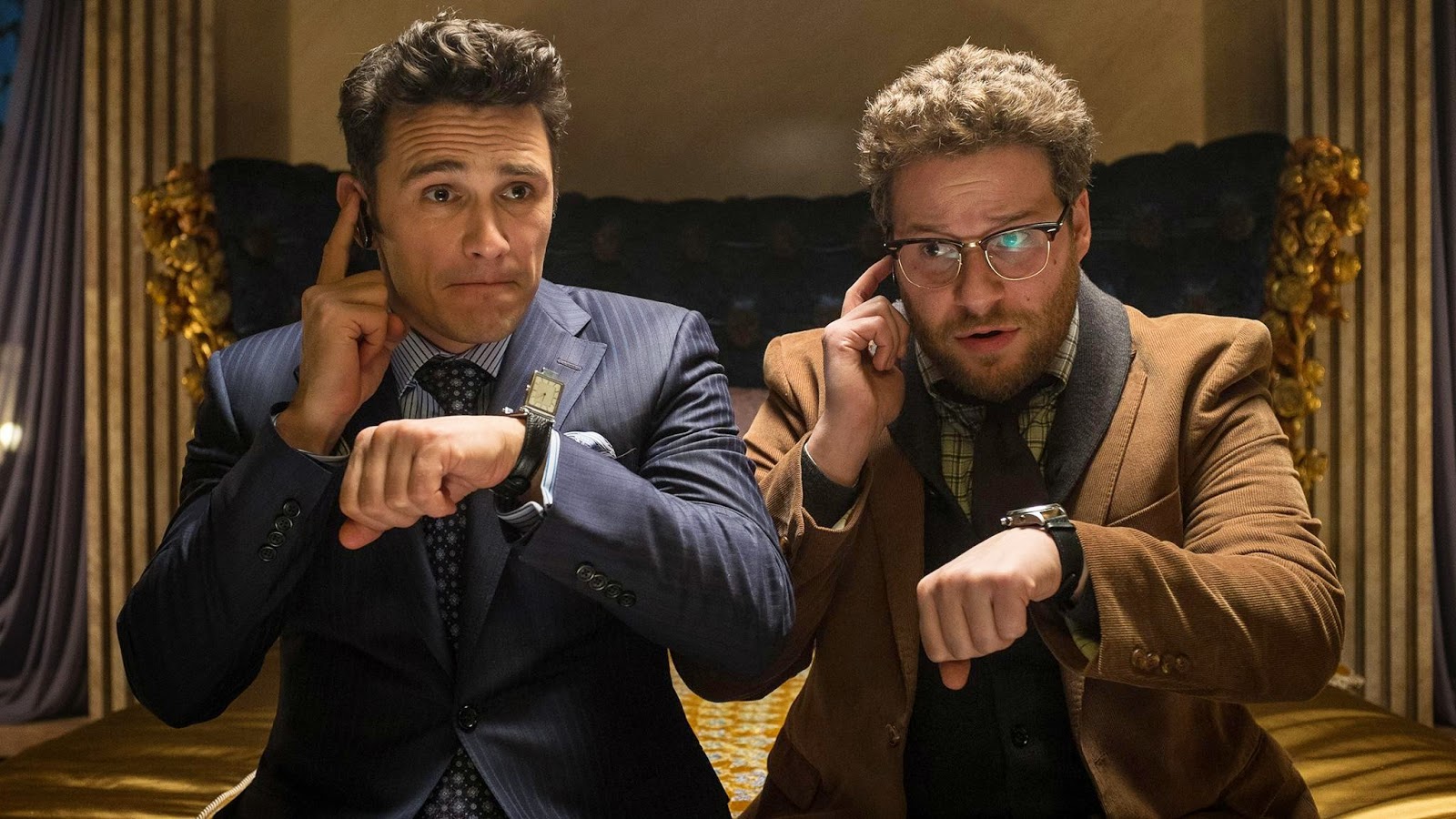
What is it about the pairing of James Franco and Seth Rogen that inspires such screwy exploits? Isolated, here are actors with plausible conviction in a diverse array of material, but together they bring about a level of bizarre physical abnormality, like friends in a college frat-house who get off by making everyone around them believe they have suffered brain injuries. That is perhaps less amusing than it sounds, but try telling that to either of them; their synergy and enthusiasm is so beyond persistent that it’s almost infectious, even when it is directed towards trivial fluff or disposable internet shtick (case in point: the endless supply of YouTube videos they have put together over the past year). They are definitive occupants of that dreaded “bromance” moniker, but it’s impossible to dislike the good-natured purity of their shared antics, and there are moments when we smirk at their mutual audacity for whatever obstacles they are up against. It’s just a shame that their robust friendship has to play out in the frames of very bad comedies.