The space inhabited by the characters in “The Devil’s Rejects” is a laboratory of unconventional challenges, of ambitious morality tests not ordinarily reserved for an ensemble of would-be horror movie casualties. Its existence comes down a tricky gimmick seized by Rob Zombie, the writer/director, who finds an interesting platform to stage the events on – one in which homicidal maniacs are hunted by a legal authority who seems driven by the same barbaric tendencies as those on their own killing spree. Driven earnestly by a mission he refers to as the “cleansing of the wicked,” this maniacal force – a Sheriff known as John Wydell – strikes a chord in others that clouds the certainty of a horrible act with that of a deserving retribution, and both sides of the equation meander in the outskirts of their inevitable confrontation like they are hoping to avoid the central point. That is not to say the movie itself is evasive about the issue it raises, but more to suggest the discomfort from asking the difficult question: when you castigate those who have committed heinous crimes with the same level of depravity, are you any better than those you punish?
Showing posts with label ROB ZOMBIE. Show all posts
Saturday, November 25, 2017
Thursday, May 25, 2017
31 / **1/2 (2016)
Horror films have so thoroughly grappled with the homicidal psyche that it’s little wonder they would come to celebrate murder as a sporting event. Rob Zombie’s “31,” molded in the image of the recent “Purge” series, supports that theory with the conviction of a bloodthirsty showman. That this is the same filmmaker who discovered the deviants of “House of 1000 Corpses” and “The Lords of Salem” is hardly a surprise, especially to those who will be quick to spot their stylistic parallels, but a certain morbid humor lifted those endeavors into different spaces of reasoning. So is not always the case with this film, however, in which a host of carnival workers are kidnapped, imprisoned and sentenced to 12 hours of life-threatening obstacles as a series of psychotic killing machines are sent off to hunt them down. “The Purge” at least saw that premise from a relevant political subtext. As I watched Zombie’s latest, however, I was less convinced that he was dealing with powerful philosophies (much less a tongue-in-cheek awareness) and more apt to believe he was trapped on the hamster wheel of his own overwrought artistic values.
Saturday, October 1, 2016
Halloween / *** (2007)
Masks are an integral device for the characters in Rob Zombie’s films, a tool that allows their dark agendas to manifest in the comfort of an elaborate masquerade. They seem to be, to them, a protection ward of sorts: to possess one implies that a victim may never be able to connect with the face of the person harming them, an essential function of holding power in a moment of violent aggression. A more revealing display would undermine the point of the pain they inflict. This is not elusive wisdom to any filmmaker that has ever overseen a vehicle involving murderous maniacs who wear such disguises, mind you, but almost always they were simply a ruse to keep audiences from discovering the identity (or at least the face, usually disfigured) of the culprit. But as we gradually move our way through the career of one of the more notable horror film impresarios of the 21st century, deeper reasons behind the implication are now at the forefront of discussion, and the line separating a dependable gimmick from its underlying psychology is gradually fading into the reveries of the past. Now it is hard to watch any film about such villains without instantly thinking of how thoroughly the façade unleashes a beast rather than hides it.
Thursday, October 30, 2014
House of 1000 Corpses / *1/2 (2003)
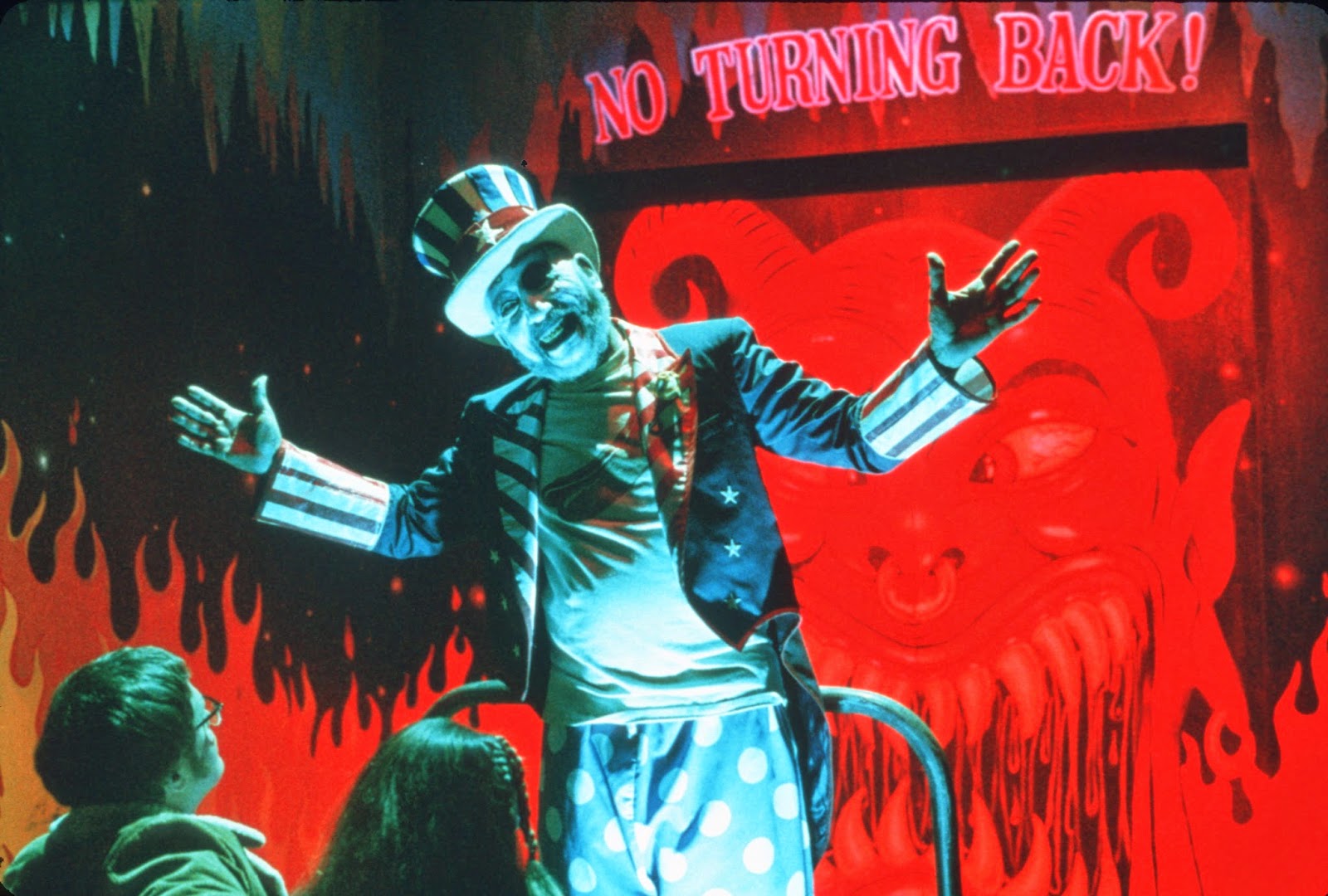
Rob Zombie’s “House of 1000 Corpses” is a movie by a man without any sense of modulation. The camera arrives in his possession like a discovery of unprecedented importance; standing behind it, the air of his enthusiasm seems to overflow with every sharp camera angle and quick edit that emerges from his zealous fingertips. For most first-time film directors, the opportunity to take one’s bizarre visual flair and incorporate it into the frames of a motion picture would be an opportunity worthy of some level of focus, however eccentric. Alas, here is a man so enamored by the notion that creative control has been passed to him that the end result lacks a central distinction, and meanders through five or six moods with extremely disconnected results. Somewhere underneath heaps of overwrought images and flashy cuts meant to, I guess, emphasize the schizophrenic nature of his screenplay (which he also wrote), traces of a viable filmmaker are aching to connect with encouraging audiences. Those who will herald his debut effort as some sort of profound revelation will not be picking my selections during late night horror movie marathons.
Subscribe to:
Posts (Atom)