Showing posts with label 1976. Show all posts
Sunday, September 26, 2021
Taxi Driver / **** (1976)
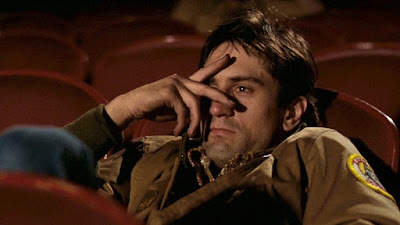
Like the most notable of cynical movie narrators, Travis Bickle arrives in “Taxi Driver” less an observer and more a force of nature nearing the breaking point of his stability. What separates him from a breed of other loners eager to critique the system is how far he is willing to go in dismantling it. This is not a man who gazes directly at the cultural construct of 1970s New York with pragmatism, and when he becomes driven to shake up its foundation, each choice plays like a step further away from a tangible moral center. In many instances that can be amusing to watch, at least when the results are uncomfortable rather than dangerous. Consider his interaction with women: early on he attempts to earn the interest of Betsy (Cybill Shepherd), a political volunteer for an aspiring presidential candidate. At first she is just as amused by his blunt worldview as we are, until their first date ends up in a seedy theater showing porno. Now contrast that to how he approaches Iris (Jodie Foster), a 12-year-old prostitute whose eyes seem to plead for him to save her – admirable, perhaps, if you were to just passively observe the behavior. But while his is a pattern that is the staple of many movie characters whose madness walks in the guise of noble intentions, rarely are they this frontal, or so pointed in arriving at the core of the crumbling psyche.
Monday, June 29, 2020
Eaten Alive / *** (1976)
Much of what occurs on-screen in “Eaten Alive” is rooted in the sort of exploitative chutzpah of 70s horror films that frequently inspired those first audiences to recoil in utter disgust. Already familiar with those dubious qualities from his “The Texas Chainsaw Massacre,” of course, director Tobe Hooper committed to a similar premise that might as well have been transcribed from the diary of those original maniacs: a motel manager with crippling nervous ticks routinely invites strangers into his run-down establishment, terrorizes them and then murders them in cold blood before throwing their bodies – sometimes while still breathing – over the edge of his porch for a nearby crocodile to feast on. Occasionally, those victims will include relatives of prior victims, who go in search of their lost loved ones by retracing their steps right back to the spot of their demise. Yet somehow they resist all initial urges to question the shady nature of the establishment: stained wallpaper, rickety stairs and unstable floor boards all seem to suggest that a place like this would have been long condemned by the health board, much less been allowed to run a continuous operation. How do they allow themselves to dismiss skepticism long enough to accept lodgings? Why do they feel comfortable leaving behind their own belongings while they venture back into the city searching for clues? These are the impulses of men and women who have never even heard of a horror film, much less ever been in a situation where they are asked to exchange platitudes with eccentric recluses who smell of violence and shame.
Thursday, September 24, 2015
Lessons from Criterion:
"Watership Down" by Martin Rosen
At the heart of every resonant childhood fable is a creature of nobility, wandering cautiously through the minefields of danger without surrendering to defeat in a contemptuous domain. In recognizing that prospect through chronicles of ambitious animals, few have been as captivating as rabbits. How do such small, seemingly inconsequential beings become profound avatars of such purity in conviction, though? Is it some unseen source of wisdom they possess, or something evolutionary? Writers have spent generations grappling with those perspectives in a wide array of subjects, but seldom have they been as consistently generous – or as deeply affecting – as those involving the lives of shy, burrowing rodents. Their eternal plight in an existence against bloodthirsty predators seems to provide an apt context in recognizing the lost qualities of our primal instincts, and there is dialogue in “Watership Down” – the greatest story ever written about a rabbit – that frames them in the embrace of an eloquent aphorism: “All the world will be your enemy, prince of a thousand enemies. They will catch you, and kill you… but first, they must catch you!”
Sunday, October 12, 2014
Burnt Offerings / ** (1976)
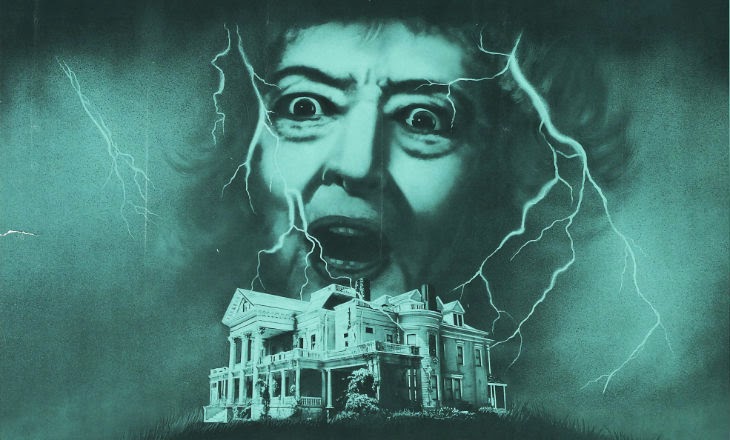
“Burnt Offerings” is one of those all-too-familiar movie detours through the doldrums of horror mediocrity, a film about a family of would-be caretakers who decide to leave behind the bright lights of the big city and spend the remains of their summer in the comforts of a charming countryside mansion that is being rented to them by, we gather, rather suspicious owners. Because they proceed to live in said property without the slightest awareness in the conventions of basic movie composition, that presents immediate disconnect in creating a relatable experience. What people in their right minds would so eagerly agree to submit themselves to such a shady arrangement given the nature of the scenario, which involves two elderly – and rather creepy – homeowners who insist on leaving their mother behind in an upstairs bedroom for the caretakers to look after? Did it not strike a mental chord in any of them that a cheap price tag for such a stunning mansion might involve rather ominous drawbacks? Even little kids would howl with pessimism at this kind of nearsighted narrative entrapment.
Friday, September 6, 2013
Network / **** (1976)
The famous images of American cinema don’t always endure through generational transitions, but the sequence in “Network” in which Howard Beale explodes with rage on broadcast television will likely be studied for centuries. When it was first revealed in 1976, audiences were caught off guard by the savage proclamation – in an editorial climate that was not yet bankrupt of journalistic integrity, the moment was virtually overpowering in the way it satirized the idea of a regulated national process caving into vulgar sensationalism. Such a moment normally would have faded into obscurity along with countless others weathered by cultural shifts, but in a society that has thoroughly mimicked the movie’s core irony, it finds a distinct resonance. Could the writer, Paddy Chayefsky, have foreseen that his biting sarcasm would become the actual medium’s underlying value system? It is easily the most important and influential image of any movie about this industry: not so much funny as it is precise and visionary.
Subscribe to:
Posts (Atom)