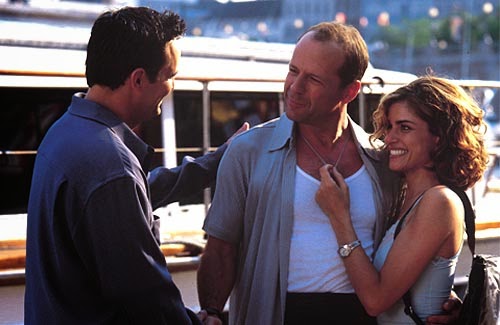
Friday, April 14, 2000

High Fidelity / *** (2000)

The tagline clipped to Stephen Frears’ “High Fidelity” suggests something short and sweet, announcing the movie as “A comedy about fear of commitment, hating your job, falling in love and other pop favorites.” It is foreseeable that the hordes of moviegoers, in pursuit of something vigorous and kinetic, will turn their backs to this campaign, fearing that the film is simply rehashed ideas and dreary exercises in romance comedy. That would be their great loss, however, since “High Fidelity,” unlike its promotional line, is filled with great energy and spirit. And in a year marauded with comedies in which characters get involved in plots that are completely absurd and fabricated, here is one that revolves around realistic people, and allows the audience to relate with their situations.

The Road To El Dorado / ** (2000)

Because of animation’s unlimited contingencies, one might wonder why it has taken so long to make a cartoon feature using one of those big treasure-hunting premises as source material. Surely you know what I’m referring to: the plots of countless live action films, such as “Romancing The Stone” and “The Mummy,” in which characters go in search of legendary artifacts and must dodge hazardous obstacles, take risks and battle villains in order to save their own lives. The feats that certain individuals accomplish on screen (like swinging on vines from one side of a cliff to another while a hot pit of lava is just below) frequently look laughable because—let’s face it—live action has its logical restrictions. Isn’t it apparent, then, that a style as eternal as animation could take these approaches and make all sorts of ludicrous actions look believable? You’d think so, wouldn’t you?

The Skulls / zero stars (2000)

Sitting in the middle of an angered audience at “The Skulls” may have been a blessing in disguise—the only element of the evening that kept me, and several theater patrons, from dozing off in their seats at the sight of a mindless catastrophe crumbling on screen. Supposedly a “thriller,” the film places its focus on a society called (you guessed it!) The Skulls, which are said to be restricted and secret, but for one reason or another have a big logo on their building so the entire University knows where they are. It’s amazing that so many viewers were still seated by the time the end credits began to roll.

Wonder Boys / ***1/2 (2000)

The irony behind every man’s destiny is that the path towards success is usually averted by unforeseeable detours. For most, such a turbulence can be caused by almost any element of everyday life: family, serious relationships, social interference, fallback from the world, employment, or a lack of enthusiasm for their fortes. An artist, for instance, can shift off-course if he or she suddenly arrives at the notion that there is no need to paint or sculpt anymore. A writer, in similar fashion, can be suspended by the inability to organize their thoughts and finish the work they have started. As a result we see such people go through mid-life crisis, retirement, depression, and other similar withdrawals from their work. Sometimes, however, those people will go in search of a muse, hoping that inspiration will break the bars of mind’s prison and, once again, set free their creative energies. Now comes a splendid little movie that finds a man on the verge of collapse with his work, but one who looks to a nearby acquaintance to find the strength, and ability, to carry on successfully.

Friday, March 31, 2000

Oscars 2000: Winner Reactions

Last Sunday night saw a turnout in Hollywood more massive than the one in London when the press found out Madonna was pregnant with her second child.

It was the evening of the Academy Awards, an annual ceremony devoted to honoring the best movies of the year in various categories; and as such, celebrities from every corner of the globe showed up to watch the contenders vie for the top prizes.

Unfortunately, like so many telecasts before it, the 72nd evening of the Oscars was nothing short of a bore—a dreary and predictable experience in which the real Oscar winners were ignored for much more mainstream (and sometimes undeserving) front-runners.

Saturday, March 25, 2000

Oscars 2000: Winner Predictions

The word "surprise" is one of the most frequently used during Oscar night, and when the Academy of Motion Picture Arts and Sciences unveils this year's winners during Sunday's telecast of the 72nd annual awards ceremony, don't be amazed to hear it a few more times.

We've approached an era in which anything is possible at the tear of the envelope, as seen most recently with the surprise win of "Shakespeare In Love," which went up against Spielberg's World War II epic "Saving Private Ryan," just last year. This time around Hollywood is treading on similar territory; Dreamworks Pictures, which owns "Saving Private Ryan," now has "American Beauty" to deal with; meanwhile the brains behind Miramax, whose campaigning of "Shakespeare" left many feeling like they had bought the Best Picture Oscar, are hoping that their much-publicized surprise hit "The Cider House Rules" will make it out on top. It's a battle of clashing forces, as it seems: both films are leaving their other competition ("The Green Mile," "The Insider," and "The Sixth Sense") literally in the dust thanks to heavy publicity. But who will actually win? Now there's a good question!

Monday, March 20, 2000

The Shining / **** (1980)

Evil has its way of manifesting in the faces of people whom we are most familiar with, and in Stanley Kubrick’s “The Shining,” one is bound to completely be amazed at how the charming image of Jack Nicholson is suddenly altered into a disturbing, unforgettable presence. The performance itself is the most incomparable of its kind; one that doesn’t require any physical alterations, but a gradual deterioration of sanity. For Nicholson himself, who has seen such transformations throughout his career (the Joker from “Batman” comes to mind), this isn’t simply a straightforward performance, but one that requires him to unleash aggression and hatred as if he were personalizing the fierce screen persona. It may be the finest performance of his career.

What Planet Are You From? / * (2000)

There is nothing sadder than seeing great screen actors squander their talent away in movies that are completely hopeless, and that is what we get with "What Planet Are You From?". How can one tell that the movie is irreparable? The idea itself is a good start--it features a planet dominated by men without sex organs, who plan on populating Earth with their own offspring in hopes that it will lead to some sort of Universal domination. It's the kind of idea that offends every form of human intelligence, and is one so dimwitted and miscalculated that, even if there had been script revisions, nothing solid could have possibly come out of the final concept.

The Whole Nine Yards / * (2000)

"The Whole Nine Yards" is a movie so stunningly bad and so incredibly inept that, for a brief while, I debated whether or not the film actually deserved a review from me. Shortly after that question entered my mind, the movie entered #1 at the domestic box office, thus providing a purpose of putting my own two cents in on this mess. A late warning is, I guess, better than none at all.

What's even more disheartening is the continuing success of the picture; while it tramples the box office competitors, great and important works like "Magnolia" and "Wonder Boys" are disappearing from the list almost as soon as they are introduced. How sad that decent moviegoers are missing films that actually have something to say and are flocking to those that merely have something to mock.

Hook / *** (1991)

The countless realizations of the childhood fantasy "Peter Pan" are more common than remakes of "The Hunchback Of Notre Dame," but probably more effective. The story visualizes a place where children can stay any age they wish, battle pirates, swim with Mermaids, and fulfill all sorts of adventures without the discipline of a parent to interfere. In other words, a dream come true for any little boy under the age of seven.

"Peter Pan" was certainly one of my faves at the time. But each of us has a soft spot for childlike myths even after the years have passed by, because such stories constantly remind us of the fearsome possibilities of youth and its many adventures. Could this explain why there are so many interpretations? Partially. But I think the subject endures so many remakes simply because it seeks exposure to each new generation. Most of the renditions, though, are produced for the stage--there have only been a handful of movies using Pan as the source material.

Jakob the Liar / ** (1999)

To see "Jakob The Liar" in its entirety is to endure "Life Is Beautiful" with ice dripping down our necks. Sometimes there are subjects in movies that do not require second interpretations, especially if they have nothing new to add to the touchy subject. What we deal with here is a second round of the holocaust, but one that is so overly dramatized by its writers and characters that one is left feeling cold and detached. No one needs a second movie in two years involving this subject to start with; when it begins playing with our minds, attempting to pass off as deeply poignant drama, then the matter gets worse.

Mission to Mars / *1/2 (2000)

Astronauts hope that technology will one day permit them to walk on the surface of Mars. Only thirty years before, mankind was taking steps on the moon, looking out into the starry universe with hopes that, in the foreseeable future, they could journey even farther than that. At any rate, though, one wonders why it has taken so long to push the boundaries (a college instructor I got into a discussion with once said that we have the equipment right now to walk on the red planet--just not the immediate desire). Machines have already been sent to the surface to take samples of the soil and atmosphere; now we merely await the next step.

The Next Best Thing / *1/2 (2000)

You've got to applaud Madonna. Here is a woman who has managed to weather every harsh criticism that has come her way in the past 17 years, both with her controversial music and her considerably-mixed movies. She's undefeatable; invulnerable to the heaviest of offenses and cruelest of remarks. But that shouldn't stop her from worrying a bit about certain aspects of her career.

Musically, she's one of the greatest women of all time; cinematically, however, very little has helped establish her as a hardworking actress. There are a couple of exceptions--both "A League Of Their Own" and "Evita" showcased talents that we never thought she had to begin with--but most work is, bluntly, complete crap. A 1993 film called "Body Of Evidence" would be exhibit A if there were ever trials that could prosecute actors for horrible roles.

The Ninth Gate / *** (2000)

Ever notice how all the new movies dealing with some form of Satanism tend to be extremely absurd? We're living in an era where anything that tries to be "The Exorcist" or "The Omen" goes completely overboard--last Thanksgiving saw the arrival of "End Of Days," featuring a story as ludicrous as an episode of "The X-Files," and before that we had "Stigmata" to deal with. While the latter film achieves some thrills, its nonsensical plot outline prevented the real scares from ever showing up.

This, to a certain effect, is the core problem with Roman Polanski's "The Ninth Gate." Here is a story that almost no one will be able to comprehend--one that is confusing, odd, dimwitted and often unbelievable. But I find myself recommending the picture regardless. Though the premise is considerably shallow, and it shifts back and forth between intriguing and ridiculous, the lush imagery presents us with high energy and is so well shot that we want to keep watching.

Friday, March 10, 2000

Boiler Room / ** (2000)
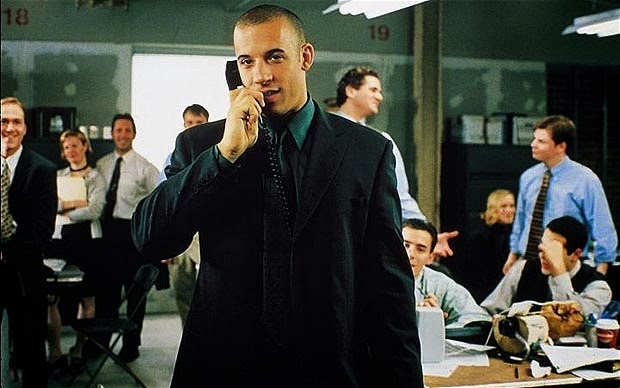
"Boiler Room" features an array of characters who watch movies like "Wall Street" and "Glengary Glenn Ross," and who strive for excellence in their careers even though greed and dishonesty are the only two things that influence their effort. These are among the most self-centered players seen in a movie for quite some time, brokers of a Long Island stock company who pounce on innocent buyers, sell them phony shares, collect the profits and actually get away with it. In a place where the only thing that matters is a paycheck, one expects lots of things to happen. Nothing is sadder, though, than seeing such promise dashed when the picture retreads to the obvious and borrows its energy from other films. This is exactly the kind of problem that plagues "Boiler Room"; its promising characters are completely eclipsed by the routine plot, which is so dreary and predictable that watching the events unfold becomes somewhat of a checklist.