The bridge persists as a stubborn link between a decaying empire and imminent liberation, defended enthusiastically by seven young men on the precipice of mortal danger. They wear masks that distort their notion of the inevitable, but not merely out of ignorance; they have been molded by the vehement enthusiasm of nationalism, which remains unchanged even after buildings have crumbled and soldiers have been erased from the battlefields. Most of them are all too eager to step in as defenders of their treasured Reich, though the faces of their parents reflect a more anxious concern. In one notable moment, for instance, one of the mothers tearfully pleas with her son to ignore the drafting letter he has received, insisting that he flee to the country to stay with relatives. He declines, grinning the whole way, which places emphasis on the underlying conflict: can these teenage boys be faulted for being slaves to the pure and idealistic, even as the possibilities of triumph seem lost in a haze of downtrodden confessions? Perhaps it is more sobering to see them as symbols of the uncultivated, especially under the rule of the Nazis: because this essentially made them the most expendable in an impending fight against enemy combatants, an obligatory defeat only aggravates the wound created by their destructive occupation.
Showing posts with label NAZI GERMANY. Show all posts
Monday, June 4, 2018
Monday, November 14, 2016
Denial / *** (2016)
Most arguments about the validity of historical events originate from a flaw in the details, and none have thus far been discovered that would alter most of our personal feelings about the atrocities of World War II. A lifetime’s worth of stories and photographs are all that remain of the horror of the Nazi era, for instance, but with them rests a certainty that seems impossible to negate, even from the perspective of those completely removed from the prospect of research or understanding. But in some circles is the pessimism to challenge the very notion of the existence of the holocaust itself – an implication that one’s failure to document an important observation (or to point to a superficial flaw, like the design mechanic of the construction of a camp) must automatically negate the fact that so many people were systematically killed by German fascists. Those sorts are the kind of people who passively nod with the likes of David Duke, once quoted as saying that “we must free the American government from subservient Jewish interests.”
Sunday, May 8, 2016
Son of Saul / **** (2015)
The sad and disquieting holocaust tragedy “Son of Saul” compels us to ponder a myriad of difficult questions, but none greater than this: what is it about a person’s face that gives a movie such decisive emotional meaning? The great Ingmar Bergman believed expressions were the passage to one’s very soul – a device that mirrored the pain and confusion of the human experience – and his movie camera frequently studied them as a means in dealing with agonizing moral complexities. If that doctrine rings true in the minds of more modern thinkers, then it is little wonder László Nemes, the impassioned Hungarian filmmaker behind this endeavor, carved his picture in the image of that sentiment. This isn’t a straightforward retelling of one man’s struggle in the hell of a Nazi concentration camp, as a reading of the premise would suggest – it is an observation of behavior that is dictated by a terrifying pattern of military orders, murder and persecution, and how one’s endurance can reduce such realities to a blur of confusion when the hope for a good deed lingers beyond the line of sight of an unending massacre.
Saturday, March 12, 2016
Triumph of the Will (1934)
Among the hundreds of endeavors of the 20th century that helped define the intricate language of cinema, two in particular were made from the fuel of dangerous personal ideologies. The first was D.W. Griffith’s “The Birth of a Nation,” and the second was Leni Riefenstahl’s “Triumph of the Will.” Both movies represented a time when historical doctrines could (and often did) disrupt the social progress of their audiences, and yet through them a few of the most revolutionary technical achievements were realized – some that would even go on to set the tone for nearly all filmmakers that were to follow. But to watch them now and regard their aesthetic triumphs is to struggle with the context in which they are used, sometimes to an end that creates alarming moral uncertainty. Can we suspend that which we are at odds with for the sake of admiring the indelible techniques that were born from their ambitious frames, or must we, indeed, consider art as an impossible measure when it is done in the provision of evil deeds?
Friday, July 10, 2015
Inglourious Basterds / **** (2009)
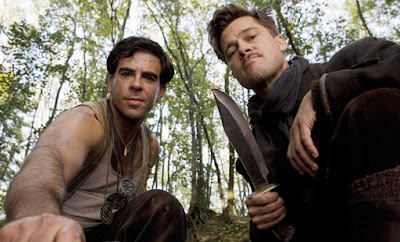
For most filmmakers, the first 20 minutes of “Inglourious Basterds” would have been a revelatory accomplishment; for Quentin Tarantino, they are just another demonstration of a transcending artistic philosophy. It all begins with the ominous arrival of a caravan of Nazis at the farm of a noble Frenchman and his daughters, each of whom look upon their sudden fate with the sorts of morose gazes that seem to hint at an ongoing custom of exchange. One of the Germans, a Colonel who has been branded the “Jew Hunter,” has come to investigate the unanswered disappearance of a Jewish family living nearby; they have not yet been accounted for, and in the thick of world war, an unclaimed enemy of the state – especially for the Germans – suggests an imperfect military operation. The setup is framed in a context that recalls the most pointed of western stand-offs: the key characters banter uncomfortably, exchange digressed platitudes, and then engage in a polite showdown of wits that concludes in a stretch of tragic implications, all of them executed under the weight of precise stylistic tension. But because the screenplay refuses to treat the scenario from a conventional war perspective, that also takes the material into a realm far removed from our initial expectations. It only serves to provide a modest point of interest, too; as a prologue to something more sweeping, these minutes are a precise marriage of skill and delivery, a display of flawless filmmaking to effectively arrange all the fearless impulses that will follow.
Subscribe to:
Posts (Atom)


