“If you laugh at it, you can deal with it.”
What a troubling month this has been for the world of comedy. In a short span of a few days that also saw the untimely death of Robin Williams, the loss of Joan Rivers inspires contrasting reflections. In one respect, both of these gargantuan comedic figures were distinctly different – one was a showman with an unending zest for cheerfulness, and the other was honest and sometimes intensely scathing. Both also went through immense inner turmoil that quietly drove them to use stand-up as a treatment regimen, especially in their later years; for Robin, unfortunately, such factors could not cure him of emotional unrest. What takes Joan away at the ripe age of 81 is unfortunate considering how active she was right until the end of her lengthy career, but her death brings with it the acknowledgment of the great (and sometimes unending) power of laughter: that in many cases, it creates an opportunity for us to neutralize the things that so frequently destroy our peace of mind. That she remained a steadfast champion of that belief until her last waking moment goes to emphasize her status as the most disciplined comedian of our time.
Friday, September 5, 2014
Tuesday, September 2, 2014
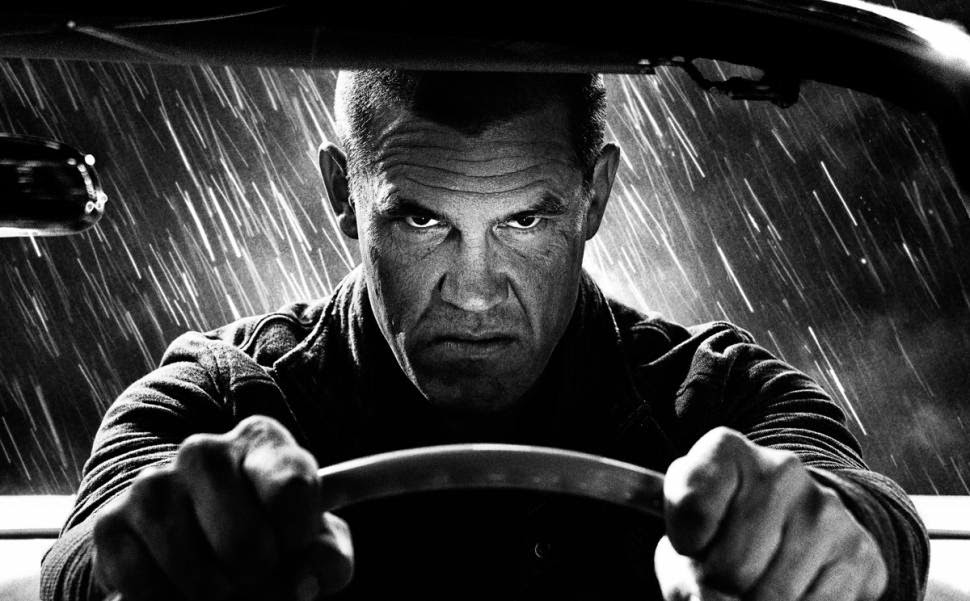
Sin City: A Dame to Kill For / *** (2014)
In the weeks leading up to the release of “Sin City: A Dame to Kill For,” Frank Miller’s nourishing cityscape of shadows and corruption weighed heavily in my thoughts. Over nine years had passed since Robert Rodriguez took us through our first outing of Basin City, and yet the visual – and narrative – impulses seemed as fresh in the current moment as they had been all that time ago, when they might have still been seen as distinctive. What gave them that edge was more than just a breathtaking sense of space and dreaminess in the images; they were compelled by an undercurrent, a chutzpah, to use the camera frame as a prison for an ensemble of characters driven beyond the limits of acceptable human behavior. The notion that their seedy antics were executed in a movie with astounding artistic sensibilities was little more than a bonus, and over the years many of us have revisited those damp streets and violent characters in unending awe of the material: marveled by the film’s evocative look and endlessly fascinated by the faces of those who dwell within them. They are, at the core, complex madmen who are only beginning to divulge their dangerous riddles.
Friday, August 29, 2014
Lessons from Criterion:
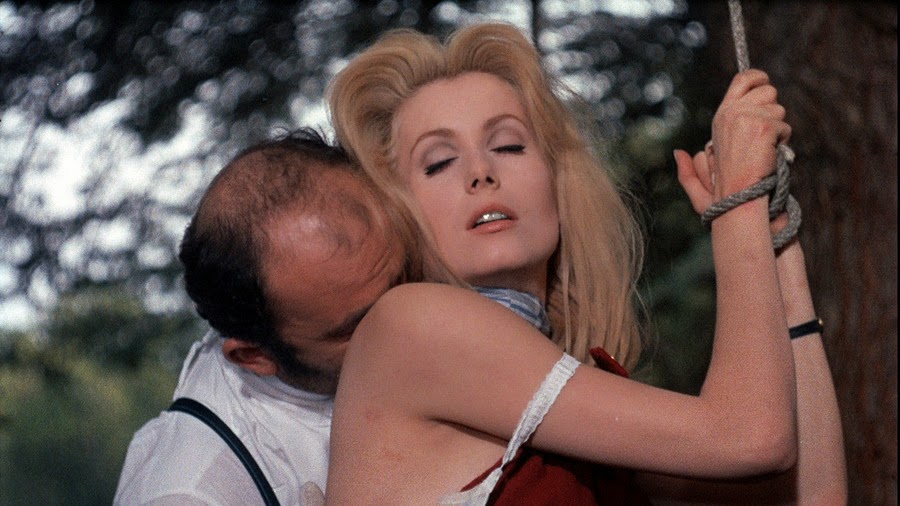
"Belle de jour" by Luis Buñuel
Few faces in the movies have contemporized storytelling standards as swiftly as Catherine Deneuve’s. When she is brought into the early scenes of Luis Buñuel’s “Belle de jour” – the movie that would ultimately announce her as a force of reckoning in European cinema – her expression is one of vacancy interlaced with ambiguous yearning, as if frozen in a moment of lost inspiration. Before dialogue punctuates those gazes, audiences are immediately drawn to her distinctive features; sharp and porcelain, they clearly do not assent to the same standards of early Hollywood starlets. The eyes are not glossed over by traditional values, either, but seemingly searching for something different, something forbidden. But of what, exactly? Are they paralyzed by the grind of a maddening routine? Are they stirred to discomfort by the unnerving finality of a marriage? Though incessantly voracious, her expressions do not draw obvious attention to the unrest in any of those around her, because that is part of her elaborate game. As the simple but calculatingly elusive Séverine, Deneuve creates a character that fills the space with a sense of wild destiny. She is not a pawn in a screenplay of emotional chess moves, but a firm hand moving around all the pieces in a game she slyly rewrites the rules for. Imagining her now, in a generation of female empowerment, is like witnessing the birth of a standard in the face of an accidental archetype.
Wednesday, August 27, 2014
Richard Attenborough, 1923 - 2014
Towards the end of Shekhar Kapur’s “Elizabeth,” the elderly advisor William Cecil is brought to a sobering concession during a scene he shares with his resolute queen. In that moment, there is no politics or intrigue influencing their dialogue – only gratitude, which briefly releases them from the enslavement of their professions so that they can share an exchange of subdued recognition. Her respect for him is emphasized in a face of growing wisdom, and the kiss he bestows on her hand is an impulse of civility that seems to hold back tears. It is not an act of defeat to be dismissed, but a gesture of goodwill for a man who gave his all for the safety of his monarch. Knowing now that it will forever be one of Richard Attenborough’s final keynote performances in a major motion picture, the scene seems to take on new life as an autobiographical metaphor, as if to suggest that the final bow was his way of saying farewell to a cinema he had bestowed so much resounding influence on for well over fifty years.
Wednesday, August 20, 2014
Wreck-It Ralph / ***1/2 (2012)
So there he is, clambering his way towards the top of a pixelated high-rise, and his gargantuan fists intend to pummel the façade until it all crumbles under the weight of his massive form. A craftsman armed with a magic hammer is the only one in a crowd of panicked figures capable of undoing that damage; if he matches his adversary’s speed and accuracy long enough to neutralize the smashing, then the building will recover, its citizens will persevere, and the destructive brute will be tossed over the side in an act of cheerful celebration. The formula is a simple pattern of competing wits, but that is all the program requires it to be, really. From those little windows inside powerful game boxes standing at the local arcade, missions present clear challenges to those at the controls: find victory in simple worlds of singular problems, and achieve a high score (or advance to later levels) before the quarters run out. What none of the players realize, however, is that the characters within these game boxes actually have their own lives and identities, and when the systems are shut down for the night, they engage one another within the walls (and wires) of a virtual society. Not since “Toy Story” has an idea for an animated movie been so audacious to assume that lifeless instruments of amusement can possess real emotions, much less the instinct to aspire for things beyond their intended use.
Monday, August 18, 2014
Deliverance / **** (1972)
“Sometimes you have to lose yourself before you find anything.”
Hindsight is an attribute that can diminish the value of films that once walked the fine line of visceral envelope-pushing, but to possess it also allows for deeper observations. Consider John Boorman’s “Deliverance” as a noteworthy example; released in 1972 well before the full disclosure mentality of filmmakers drove the underlying current of popular cinema, it was once considered the most explicit mainstream drama of its kind. Just as audiences were taken aback by the implication of simple characters stumbling into frightening realities, a good portion of viewers were greatly unnerved by another key suggestion: that the back corners of the American south could also be hotbeds for cruel and disturbing behaviors. These ideas informed an entire way of thinking that would become the running joke of southerners throughout popular culture, ultimately inspiring the likes of “The Texas Chainsaw Massacre” – that is, movies where the underbelly of horror was often localized in wooded areas populated by inbred villains. Four decades have passed since that approach left an imprint, and nowadays the ideas are commonplace and tired, and often without artistic foundation. To see them at the source, in a movie far removed from the desensitized nature of modern violence, is like staring back at a relic. And yet despite such facts Boorman’s film still speaks to us in profound ways, as if to indicate hidden wisdom has long rested in frames glossed up by a once-shocking philosophy.
Tuesday, August 12, 2014
"Elizabeth" Revisited
“It is a masterful exploration of the rich and fascinating world of Elizabethan England; the story of the Virgin Queen, the court’s rude luxury, and the atmospheric tones of life behind the castle walls scramble off the screen like deep hidden secrets of the past just waiting to be revealed.” – taken from the original Cinemaphile review of “Elizabeth”
In a key moment of dreamy perfection, a scarred monarch stares back at her reflection in the mirror and announces, unequivocally, that she has “become a virgin.” What is she suggesting? To understand the implication, one must comprehend the veracity of her journey up to that one moment. In 16th century England, political unrest has paved the way for violent religious persecution, and a Catholic rule is threatened when its current queen, Mary Tudor, becomes terminally ill before producing an heir. All thoughts of the crown falling to her sister Elizabeth, a Protestant, inspire proclamations of damnation, and her almost childlike naivety serves to create an emotional current that amplifies the exploits of her devout enemies. But scrawled across this face of intense consideration is the soul of a woman bound to unwavering endurance, and as her command over the country is tested by quiet betrayals occurring all around her, she comes to see this moment – this one revelation – as the only means of rising above a difficult world of violence and suffering. That she has to discover the necessity of this impulse out of terrible heartbreak (and murderous plots) is as sobering as it is tragic.
Monday, August 11, 2014
Robin Williams, 1951 - 2014
“When in doubt, go for the dick joke.”
Reminders of our mortality usually arrive in cruel increments. Today, a collective sweep of grief underscores that notion as we are hearing news of Robin Williams, who at age 63 was found dead this morning in his California home of mysterious causes. Specifics regarding his untimely demise are ongoing, but there is one thing that will persevere as a certainty in the wake of this reality: Williams was more than just a good actor and comedian, he was also a man whose endeavors were delivered with such consistent zeal that it garnered him millions of enthusiastic fans. While most applauded his comedic ability – namely, his penchant for embodying characters of endless quirk, and his knack for skillful improv – it is his endeavors in a slew of thoughtful dramas that resonate in this moment, and seem to emerge as the first thing on our minds as we reflect on his remarkable career.
Friday, August 8, 2014
The Story So Far
It was sixteen years ago when the movies emerged at the forefront of my professional aspirations. The first film that sparked that drive was Disney’s “The Black Cauldron,” which had just been released on VHS after years of being buried in the vaults. Following an eager viewing, I sat down – as I had done so periodically early on when writing reviews for the school newspaper – and cranked out a five paragraph analysis in just a few short minutes. The endeavor had been at the request of an old user-owned web site that initially launched as a petition to release said movie, which was now taking articles from an influx of enthusiastic new viewers as a way to celebrate the long-delayed arrival of their obscure treasure. From that moment on, my new venture merged fluidly with the pursuit of an identity in the new frontier of the world wide web, and words poured from the mind like liquid without obstruction.
Sixteen years later, I sit at a desk in contemplation of milestones. What are the odds that the first proof copy of my first volume of articles would show up in the mail on the very anniversary date that my first review went live on the Internet? Who could have guessed that it would reach my hands in the same week that I finished writing my 700th full length film review, which has already broken a long list of traffic records? Fate and coincidence seem to be interchangeable words when projected into windows of perspective, but in these travels there exists an urgency to reflect. Because the world is barreling past us in a sweep of maddening velocity, moments to pause are a rarity. But they must be done, especially if we are to understand anything about ourselves beyond surface intrigue.
Sunday, August 3, 2014
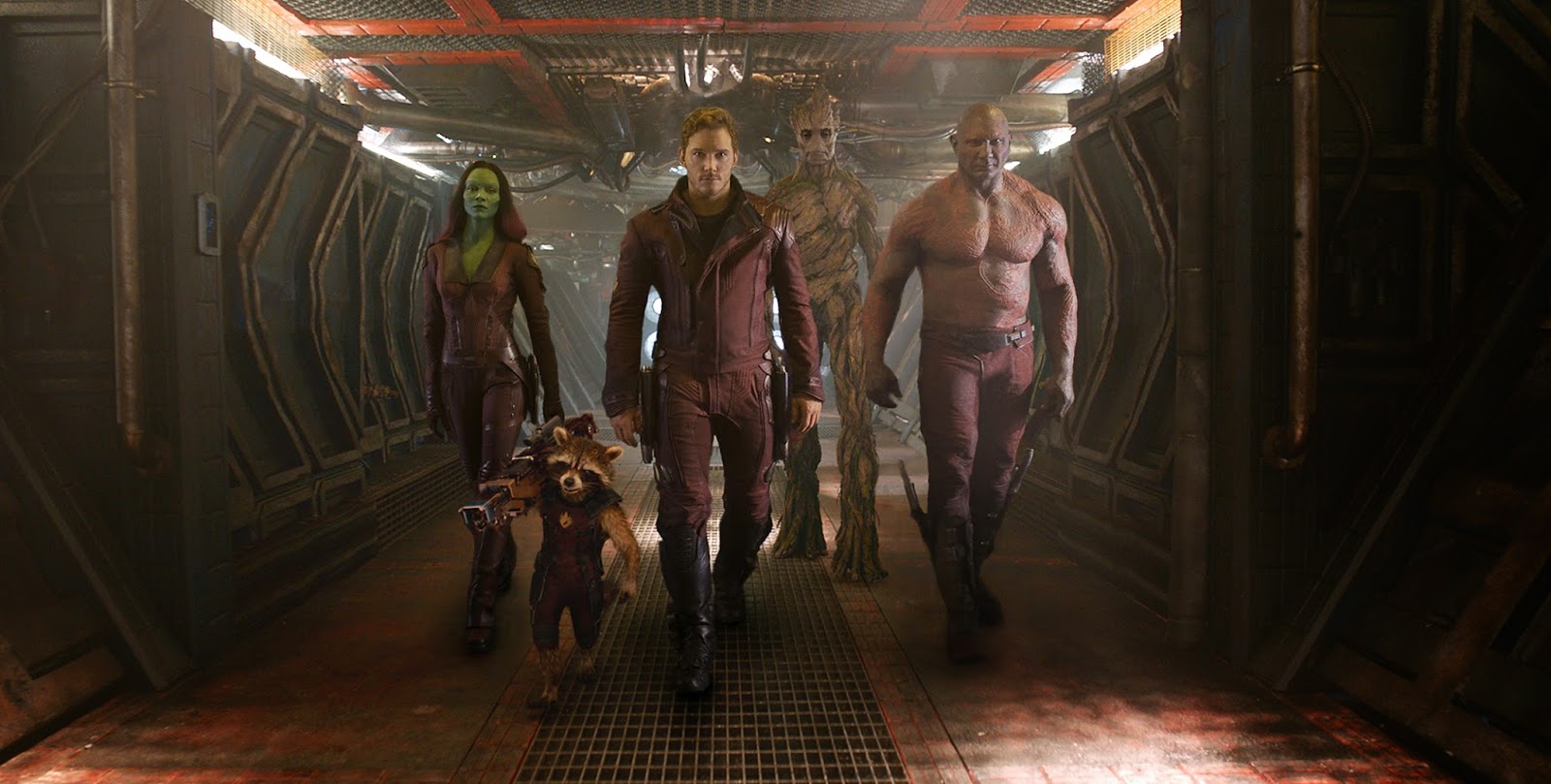
Guardians of the Galaxy / ***1/2 (2014)
When a crowded genre comes to the point of being saturated by clichés and wall-to-wall adrenaline, sometimes a little silliness can go a long way. “Guardians of the Galaxy,” the newest (and most eccentric) of the Marvel comic book movie adaptations, is a mad act of absurd genius: refreshingly creative, quirky, well-staged, beyond visionary, often hilarious and fueled by imaginations that seem to tap into an obscure corner of the mind in order to create an endless array of wondrous images. It left me with the kinds of sensations normally reserved for deep and meaningful science fiction epics. That this comes as a major surprise only makes the response all the more enthusiastic. Who would dare suspect that a preposterous little story of unattractive renegades could inspire high amusement, especially after we have been overrun by traditional superheroes caught up in an interlocking battle that demands rigorous stamina and far-fetched conflicts? No recent summer movie has taken such bold risks and gotten completely away with them, much less offered an audience a thrilling adventure in the company of thoroughly original characters.
Thursday, July 31, 2014
The Descent / **** (2005)
A critical window of insight is what separates the characters in Neil Marshall’s “The Descent” from the disposable line of victims normally seen in modern horror movies. It occurs in the opening scenes, when three female friends are out rafting enthusiastically through treacherous river waters. They share laughs, shouts of warning, and occasional lighthearted screams. Their antics are spied by a man and his daughter from a nearby hillside, both of whom are there to cheer on Sarah (Shauna Macdonald). She is the wife and mother, a woman with few cares in the world beyond this current moment. When the raft pulls into an embankment and the three friends begin to part, awkward glances are exchanged between the man and Juno (Natalie Mendoza), Sarah’s other friend. The third catches sight of these gazes, but does not convey a response beyond internal fascination. And then in the next scene, Sarah and her family are on the road heading back into town when tragedy strikes: he veers accidentally off into the lane of incoming traffic, and a head-on collision with another car ends with the deaths of husband and daughter. Later, long after their world has collapsed under the weight of horrific new adventures, one of them makes an observation that effectively frames the entire premise of their interactions: “we all lost something in that crash.”
Monday, July 28, 2014
12 Years a Slave / **** (2013)
Steve McQueen’s stark, powerful “12 Years a Slave” leaps far beyond the notion of basic film composition and penetrates to the core of the human condition, at a time when the acts of a people left a stain on our civilization from which there could be no return. To see it – and indeed, to experience it – is to be part of one of the most haunting encounters we will ever have with a movie screen. Based on a prevailing memoir of one man’s perseverance during the years of American slavery, the film is the embodiment of historical resonance, and McQueen doesn’t so much direct a picture as he allows his mind to be a vessel for unflinching candor while a camera bears witness. Here is an endeavor so brutal, so honest and stirring, that it inspires a collective pause akin to what “Schindler’s List” did for the subject of the Holocaust.
Saturday, July 26, 2014
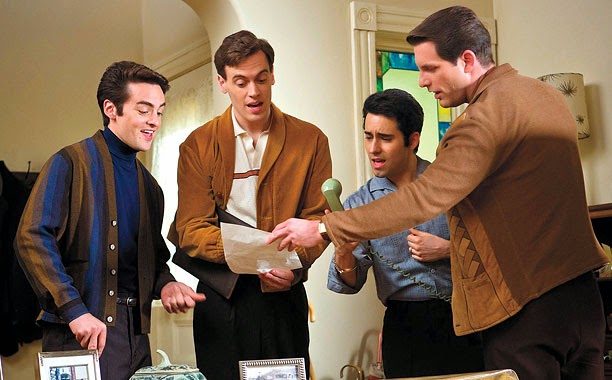
Jersey Boys / *** (2014)
There’s narration in “Jersey Boys” that calls to mind the approach of “DeLovely” and “Beyond the Sea,” in which musical stars of the 50s and 60s possess hindsight in what will transpire in their eventful lives. Why exactly do those years call to mind a desire for writers to turn their characters into all-knowing observers in their own histories? Does relating the events through a modern perspective add something significant to the approach? A context, perhaps? For the four young men at the center of Eastwood’s newest movie, it is characteristic of a trend that suggests those times are now too distant for today’s audiences to relate. Here emerges a chronicle of young ambitious musicians who are just starting to find their place and write their legacy, but they speak directly to the camera as if stand-ins to “The Jersey Shore”; they are blatantly vulgar and contemporary, and driven by short-sighted indulgences. And yet their deliberate foresight also serves as some kind of elaborate warnings sign, a prolonged metaphor that seems to underscore the naivety of all aspiring stars in the age of artistic unrest. How unfortunate that the old adage “if only we knew then what we know now” doesn’t allow them to affect such details, even as they watch on fully knowing what fate has in store for them.
Thursday, July 24, 2014
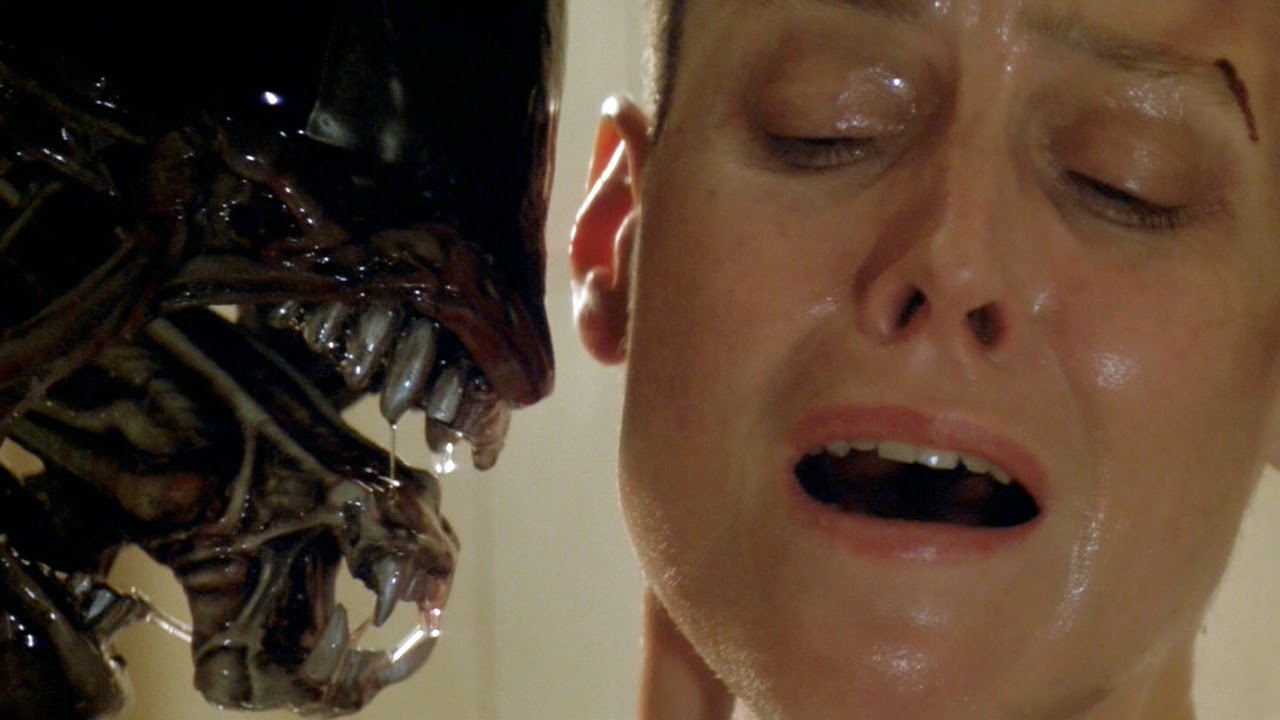
Alien 3 / *** (1992)
“In an insane world, a sane man must appear insane.”
The opening images reverberate with distinct tension. A leathery egg appears in the corner of a chamber, recently opened. The window of a cryotube cracks as something unseen scurries nearby. A generic computer voice overhead warns of an internal fire. Then there is a shot of a facial x-ray, with an alien specimen latched on. Acid blood spills on the floor, eating away at it. For those well versed in the stories of the “Alien” pictures, these moments foreshadow a familiar reality: the slimy creatures have left behind a terrible present on this escape pod, and the three survivors of James Cameron’s brilliantly effective “Aliens” are immediately thrust back into danger, all while their vessel passes silently among the stars. That they face this danger while still in hyper sleep is one of the many challenging moments of this, the third picture in the franchise, but their intentions remain in doubt for many seasoned observers: was this collection of shots an attempt by a then-inexperienced director at taking a story arc to the brink of its potential, or were they merely moments of blinding miscalculation meant to abandon the momentum set up in the previous entry?
Thursday, July 17, 2014
Hitler's Children (2011)
Five names, five lives forever cast in the shadows of evil. Their faces are hard-worn from existences that seem almost otherworldly, their expressions indicative of countless years of brooding and self-loathing. Who are they? What significance do they hold? Has their experience lead them to outright detachment? They are some of the last descendants of the Nazi empire, and coursing through their veins is the blood of a legacy that will forever haunt them, torture them, and subject them to certain social exile. That they have spent their entire lives atoning for the sins of their ancestors is critical in the study of their troubled lives, but why should they have to go through all of that now, so long after the dust has settled? Are the horrors of our parents and grandparents so potentially horrific that they could, quite possibly, reverberate into the histories of those who come long after?
Subscribe to:
Posts (Atom)