Friday, June 8, 2001

Summer 2001: An In-Depth Preview of Things to Come

Though the summer movie season is widely considered to be a three-month excursion into blockbuster territory starting in June, it actually just recently began kicking off in early May, when Hollywood studios began to see how major motion picture releases during the month were quickly becoming major hits. For the past decade, major revenue began generating off of the Memorial Holiday weekend, and just two years ago, both “The Mummy” and “Star Wars Episode 1—The Phantom Menace” proved beyond a shadow of a doubt just how eager moviegoers were starting to get for their favorite movie season. Now it seems everyone wants a piece of the action; last year, Academy Award winner “Gladiator” was May’s hot ticket, and just these past two weeks, the highly anticipated “Pearl Harbor” ate up a good percentage of weekly box office receipts.

Friday, June 1, 2001

Summer 2001: Where Have All The Ideas Gone?

It’s becoming increasingly apparent that many of today’s filmmakers are losing their inspiration.

Those who share a similar opinion about Hollywood’s latest offerings need not to look any further then the schedule of summer movie releases that have been laid before us. Of the more than two dozen major releases being planned for the June-to-August calendar, around half of them are either sequels, remakes, or adaptations of existing source material. While familiarity isn’t necessarily a bad thing, too much of it can easily lead to a feeling of repetition that can quickly turn off many viewers. Now, with so many releases on the horizon devoted to revisiting far-too-familiar territory, many can’t help but wonder: where have all the fresh ideas gone, and are moviegoers even interested in all the retreads being offered at the movie house this year?

Bridget Jones' Diary / ***1/2 (2001)

We’ve always been told that it’s impolite to read someone else’s diary, but what if someone’s deep and personal secrets were unknowingly brought out into the open for a whole audience to see? That’s the essential situation utilized in Sharon Maguire’s “Bridget Jones’ Diary,” in which a British singleton in her thirties decides to lose weight, stop smoking and dive into the pool known as romance. After being dismissed by an attractive man at a Christmas party, the quirky and tempered sexpot vows to reshape the structure of her dead-end life, and one of the tasks on her “to-do” list is to keep a diary of all of her experiences under this new umbrella of reasoning.

A Knight's Tale / ** (2001)

"A Knight's Tale" tries very hard to be one of the year's most carefree good times, but its lapse in logic creates a deafening interference for the moviegoer to deal with. Few people have probably not heard by now about how the movie uses a classic rock soundtrack against a medieval setting, but even fewer might not realize just what kind of intense distraction this has on us, not just as sensible viewers but as moviegoers in the spirit of silly summer thrills. It's great to have fun, but even the most mindless occasions call for a little plausibility, and this is the kind of movie that has no interest whatsoever in at least operating inside respectable boundaries.

The Mummy Returns / ***1/2 (2001)

Stephen Sommers’ “The Mummy” is chiefly thought of as a lightweight and brainless action adventure, but that’s probably exactly why it became one of the biggest hits of the 1999 summer movie season. Filled with endless plot absurdities and cheesy CGI effects, the highly successful action adventure starring Brendan Fraser as an adventuresome grave-robber impeccably captured the proper essence of the conventional summer release: the movie where a plot doesn’t matter and characters are secondary to an incessant ride of surprises and thrills. Critics faulted it for being “silly” and “unbelievable,” but think about this for one moment: compared to the “Indiana Jones” franchise, just exactly how silly and unbelievable would you call it?

Pearl Harbor / * (2001)

The Randall Wallace screenplay that offers a romance-driven rendition of the infamous World War II disaster at Pearl Harbor serves as the newest in a long line of excuses for director Michael Bay and producer Jerry Bruckheimer to waste ambition, talent, money and time on a production built around loud noises, gigantic explosions, and not much else. Perhaps we would not be so willing to cave into advanced negative perception, though, had either of them actually done something halfway respectable somewhere in the duration of their incessant careers. The fact is that their adrenaline-pumped endeavors care about little of anything other than numbing the senses, and judging by the latest offering in their endless cycle of big-budgeted drivel, neither has any interest in taking one simple subject seriously either, never mind the fact that they aren’t just tinkering with emotions and special effects this time around, but history itself as well.

Wednesday, April 25, 2001

Along Came a Spider / *1/2 (2001)

The villain referred to in the title of Lee Tamahori's "Along Came A Spider" is not the innocuous arachnid who "frightened Miss Muffet away" in nursery rhymes, but instead a viscous and manipulative psychopath who creeps between the cracks of the plot without fear of being discovered by someone who just might unravel his web of deception. He also doesn't seem to mind much that he's wandering around without a sense of what he's doing, or what the point exactly is of his endless mind games. And that's an even bigger problem with the movie than you might first suspect, because the protagonist of the picture, a forensics detective named Alex Cross (the always-admirable Morgan Freeman), is so smart and alert in his police investigations that even more cautious criminals would not likely slip through his fingers. Watching him wade through this incoherent mess is like seeing a good baseball pitcher benched for the season; he has the talent and the ambition, but the situation he's in just doesn't give him the opportunity to show off the way he deserves to.

Appleseed / *** (1988)

The hidden power of Japanese animation is not always about the quirky artistic style, but more about the deep level of story and metaphor the movies contain. Think of the mind-numbing and twisted thrills of “Akira,” or the compelling fantasy of “Princess Mononoke.” Feature cartoons don’t have to be visually superior to those of the mainstream in order to be better. Nor, for that matter, do they have to restrain themselves to material that would only attract the eyes of a child. Until moviegoers are willing to understand those possibilities, mainstream cartoons will always carry a stigma that narrows them to the youth market, made up of elaborate imagery but stories with limited appeal.

Black Jack / ***1/2 (2001)

While the masses continue to be fascinated by the evolution of feature animation, little, if any, attention is ever given to Japanese animation, a genre that, although very ahead of its time, often provides some of the most entertaining and fascinating motion pictures ever created. Most recently, steps have been taken to try and create a strong awareness in the states of its existence, but much of it is undermined because the public has the image that all Japanese animation mirrors the hideous “Pokemon” craze. That is, of course, not the case at all, and Manga Video, a nationwide distributor of anime films, was founded under the belief that even foreign techniques in cinema can find loyal audiences overseas. One of their newest releases, the science fiction thriller “Black Jack,” is proof that moviegoers still don’t realize what they’re missing.

Freddy Got Fingered / * (2001)

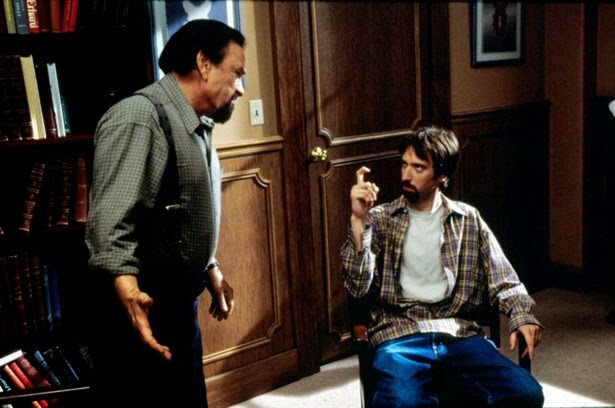
There is a moment near the end of “Freddy Got Fingered” when Tom Green and Rip Torn step from a plane, relieved that their 18-month hostage situation in Pakistan is over, and they are greeted by a cheering crowd that has turned out to see their arrivals. Of the many large signs that the onlookers are carrying, one of them announces, “When will this movie f**king end?” We know the feeling all too well by then; only 20 minutes into the picture itself, many of us with half a brain in the theater are checking our watches to see how much longer we are forced to endure the torture.

Friday, April 6, 2001

Blow / *** (2001)

If there’s one thing that movies about the drug business have always taught us, it’s that high-profile wealth and success derived from such illicit activities seldom stays around for long. Unfortunately the subjects usually have to learn the hard way. Think of two of the latest endeavors in this vein: Darren Aronofsky’s “Requiem For A Dream” and Steven Soderbergh’s “Traffic.” Both movies feature intertwining stories of seemingly normal human beings who think that an involvement with drugs (either an addiction or a job as a supplier) will bring them what they so desperately crave in life. As soon as they think they’ve accomplished their goals, however, they frequently suffer some kind of devastating setback--a prison sentence, physical or psychological damage, or in the worse case scenario, death. Any way you look at it, the only happy ending even remotely possible in these situations is the fact that it is all over.

Hannibal / *** (2001)

The eyes of Dr. Hannibal Lecter may very well be the most persuasive and paralyzing ever seen in a movie, so convincingly urbane and focused that they could coax a vegetarian into sharing one of his meals. Maybe that’s why moviegoers are so fascinated by his presence. That, at least, would explain the consistent success of Jonathan Demme’s “The Silence Of The Lambs,” a movie that, just ten years old, is already considered one of the greatest thrillers ever created for the big screen. Not all the praise is attributed to the persona, however, as much as it is to the actor who adopts it. Anthony Hopkins, being one of the best thespians of his time, is flawless in the execution of his role, bringing knowledge and insight to the cannibal’s menacing visage without getting too deep or involved in his motives. Is it a wonder that he won an Academy Award for this performance? Or better yet, was there ever any doubt that the movie would also take home Actress, Director, and Picture honors, only to be the third Oscar sweep in history?

Wednesday, April 4, 2001

Oscars 2001: Winner Reactions
Many wonder why journalists even bother to make predictions on Oscar winners; seldom are their forecasts accurate to the actual results. This year, I can certainly identify with these kinds of people.

After six weeks of long and hard contemplation and personal debates, I forged up my own, comprehensive list of winner predictions, only to have it thrown directly back in my face by a slew of surprises, upsets, and utter jaw-droppers at the 73rd Annual Academy Awards. It is always said that we cannot expect anything from the Academy, but who would have guessed so many predictions could be thrown so far off track?

Friday, March 23, 2001

Oscars 2001: Preserving the Secrecy of the Ballot

As Hollywood prepares for another ceremony in which the Academy of Motion Picture Arts and Sciences honors the year’s best in cinema, countless industry experts (most notably journalists) continue in a long and frustrating attempt to do what so far no one has been able to thus far: unveil the results of winners before the envelopes are torn open on stage.

It is a temptation that the industry has had for more than 50 years, and now, with the threat of things like Internet site hacking and academy member polling looming large over the event, keeping those well-guarded secrets hidden until the annual telecast becomes even more difficult.

Oscars 2001: Winner Predictions

In less than two days, Hollywood will be buzzing over the many celebrated victories at this year’s Academy Awards. Perhaps the anticipation preceding the ceremony may be much greater than what follows it, though.

Creeping anxiously towards Oscar night 2001, we as moviegoers are seeing one of the biggest debates among industry insiders, critics, and audiences of the past ten years: who exactly are the front-runners among this year’s nominees, and who’s to say that they won’t be upset by other highly-observed contenders? Part of the calm atmosphere that has swirled around the ceremony in the past is the fact that the majority of the winners were usually imperative; this year, almost nothing can be ruled out as a sure thing, especially since the year’s top three picture contenders (Ang Lee’s “Crouching Tiger, Hidden Dragon,” Ridley Scott’s “Gladiator,” and Steven Soderbergh’s “Traffic”) each appear to have a large voter following behind them.