Showing posts with label 1983. Show all posts

Wednesday, February 19, 2020

The Lonely Lady / 1/2* (1983)

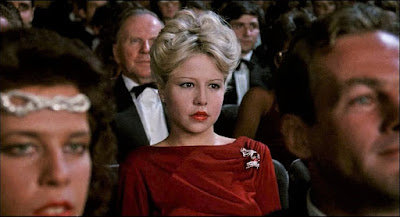
Forget, for a moment, all the dreadful things you have heard about “The Lonely Lady.” Dismiss the conventional criticisms that peg it as one of the more pronounced turkeys of its time, ranging from the shoddy acting to the implausible premise. Absolve yourself of any knowledge of Pia Zadora’s strange rise to fame, or how her entire participation in this mess came to be. Resist the urge to read through some of the cringe-inducing dialogue, avoid the temptation to blame shoddy makeup or inept scene staging, and ignore all attempts at understanding the long and notorious back-story. Those notions will only color your view. Oh, an exhaustive list of problems could be assembled about the movie in question, and few of them would be arguable, but those traits in themselves do not quantify all the reasons this film endures so vividly. Something more precise, more glaring, had to be wrong with what was on screen. After lumbering through a recent viewing, I believe I finally deciphered the key distinction: that this may be the most shamelessly evasive drama ever written.


Wednesday, July 3, 2019

Christine / *** (1983)

John Carpenter’s “Christine” is a well-made attempt to bring sincerity to absurdity, without calling much attention to the disconnects of logic that would otherwise collapse the story. Imagine how frustrating that must have been for a man that was otherwise absorbed by more palpable realities. After “Halloween” established him as a filmmaker obsessed with the possible and “Escape from New York” moved him towards a more prophetic sense of storytelling, along came a ridiculous screen treatment involving a killer car and his nutjob owner who mow down the town’s teenage bullies. Who would have guessed – indeed, predicted – that any filmmaker might develop the self-awareness to know exactly where to take this story without tipping the audience off or sabotaging their interest? “It was just a paycheck when I took it on,” Carpenter once said in a book-length interview about his career. That was a payday well-earned, and now long after the horror movie market has been saturated by sub-par adaptations of most of Stephen King’s famous stories, his end result is widely seen as one of the more effective screen treatments of the era, however corny or preposterous it may remain on paper.

Tuesday, May 28, 2019

Zelig / ***1/2 (1983)

Over a period of four years in the middle of his lauded creative boom, Woody Allen assembled the pieces of what would become “Zelig,” a faux biography about a man from the early 20th century who could physically change his appearance just by being in the company of others with similar attributes. At the time, the ambitious artifice was merely regarded as a self-contained display of his comic ability, a closed world of the sorts of wisdom and quirk than often ran unrestrained in his more mainstream endeavors. Looking back on it now, however, one uncovers a deeper meaning, particularly when we use the full hindsight of his career as the framework. Like the enigmatic Leonard Zelig, Allen harbored deep questions about his own value that were frequently sidelined in an attempt to “fit in” with the world’s perceptions, and making movies – much like changing identities – became an outlet to work through the impulses and behaviors. If the sum of his career can be seen as a series of destinations on a road to that discovery, then his strange, off-the-cuff “mockumentary” provides the most unlikely roadmap.

Friday, October 20, 2017

Sleepaway Camp / *1/2 (1983)

Of a plethora of tenacious relics that persist with some level of notoriety in the dead teenager formula, few have been as puzzling (or as maddening) as Robert Hiltzik’s “Sleepaway Camp.” Cut from the same blood-soaked cloth that gave birth to the “Friday the 13th” and “Prom Night” franchises, here was a picture heralded in the margins of filmgoing as an audacious blend of macabre visuals and social underpinnings, inevitably casting it in a light that far exceeded the expectations of its class. Others were content to regard it as harmless (if violent) fun, and those sorts might have been the first to develop long-term hindsight; better films would eventually come along to inform their palettes and diminish the lesser pleasures. But like an open wound with a relentless sting we are forced to consider this thing in the sweep of horror film history even now, despite that far more ambitious movies have drifted deeply into the annals of cinematic myth and legend. Its strange endurance, at best, emphasizes the dichotomous standards of the populists, who usually sneer in protest at a standard that freely robs the ideas of the masters while displacing their tonal conviction.

Wednesday, October 7, 2015

The Evil Dead / *** (1983)

A good horror film is not necessarily dependent on a marriage of specific qualities, but can be simply so because the enthusiasm of its creators fill the screen with almost perverse allure. “The Evil Dead,” one of the most celebrated of the classic canon, falls distinctly into the latter category. When it was first unleashed onto unsuspecting audiences well over 30 years ago, few could regard it with serious conviction; it was one of the first films of its respective genre to earn the dreaded “X” rating, and the consensus was – even among those who were completely sold on the content – that it was one of the more visually reprehensible exercises of its time. Yet it endured across the gulf of evolving artistic standards, eventually gaining prestige among a slew of genre fanboys that elevated it to cult-like importance in the subsequent years. Their reasoning: within its macabre and grotesque images are the foundations for some of the most spirited personalities of the horror pantheon, two of whom would not only go on to work together on equally popular sequels but would also lead rather fastidious careers in the Hollywood limelight. To them, the movie plays like an entry point into the infectious minds of their favorite overachievers, who did exactly what they wanted and offered no apologies.

Monday, December 30, 2013

A Christmas Story / **** (1983)

Significant contrasts exist between most movies about the holidays and Bob Clark’s “A Christmas Story,” but the key to its endurance over the years probably comes down to a certain cheerful self-awareness. Here is a movie where characters are not so much born from a script as they are molded within a tangible frame of reference, and through their sense of innocence, patience, imagination and ability to pass through situations with scarcely a shred of confidence, an image of the most bolstering movie family emerges. This, we quickly realize, creates a commodity of alarming clarity: for anyone who has ever experienced the childhood wonder associated with the festive traditions of Christmas (or the agonies of familial impatience), many of the scenes scattered throughout the picture seem to exist as projections, as if the movie camera is reaching into the scrapbook of the mind and drawing on specific memories for reference. Directors by nature look to their own lives for such inspiration, but this is an approach that is impeccably informed and organic, and Clark not only comprehends the emotions associated with suburban households in the hustle and bustle of the holidays, but somehow finds a universal elation in them.