Let’s have a serious discussion about context. Does it have a place in faith-based storytelling? Isn’t there a danger in exploiting the connotations of an event if it is far removed from the perspective of reasoning? We are hard-pressed to find a decisive assessment in many an instance of these sorts of pictures, but Mel Gibson’s “The Passion of the Christ” argues against the rules of film directors modulating their own creative process. Some level of horrific overzealousness possesses his instincts in this chronicle of Jesus’ crucifixion, empowering him to use his camera as a sadistic observer in the cruel and gratuitous sacrifice of the Christian messiah at the hands of incessant tormentors. So great is the violence, however, that his endeavors leave us with two nagging questions: 1) how, anatomically speaking, was it possible that any man (even the son of God) could survive long enough to make the ascent up the hill to be nailed to a cross?; and 2) how does the mere notion of his death lead an established veteran like him down such a grotesque and unsightly road of contemptible values? Show me any scenario that justifies these extremes and then tell me how it all fits into any framework other than pornography.
Showing posts with label 2004. Show all posts
Sunday, February 21, 2016
Monday, March 24, 2014
Napoleon Dynamite / 1/2* (2004)
When I was in high school, those of us branded as unpopular sorts were rather thankful to skirt through the cliques with minimal notice. As awkward as it is to be on the outside of teenage coteries, it is usually more discomforting to be in the crosshairs of those who relish the opportunity to expose your social dysfunction. I admired those that stood their ground when the time came for their own public ridicule, but didn’t necessarily envy their positions; many were simply too enraged or impatient to be silent, while others lacked the skill to avoid such situations in the first place. One constant between them, though, was that their unconventional traits shielded others from recognizing the often brilliant minds that were concealed underneath. Watching “Napoleon Dynamite,” I was curious as to what some of those former classmates of mine would have thought of the eccentric main character that occupies the majority of this story. Would they have been sympathetic to his inept social skills, or infuriated by his lack of mental capacity?
Tuesday, June 25, 2013
"Stage Beauty" revisited; an underrated masterpiece
What follows is part of my original review of "Stage Beauty" from 2006, but with a completely different introduction and altered first half. The original article had been reworked into an essay for purpose of publication in a book for the Online Film Critics Society, which never materialized. This "newer" version of the original analysis is from 2008, and closes the gap on unpublished material from those writing sessions. My opinion of the film has not changed in seven years, and because of such, I am justified in continuing to classify this as a "revisited" piece rather than a full-fledged review. Not all of it is new, but enough has changed to make it distinct from the original assessment.
Original completion date: November 15, 2008
Wednesday, January 12, 2005
Stage Beauty / **** (2004)
To see "Stage Beauty" in its full lively splendor is to see a work of genius revealed on screen. The movie is savage entertainment, written with the kind of panache and wit that is generally absent in most modern period pieces, and executed in a manner that allows little room for mere suggestion but an array of opportunities to be both shocking and unrestrictive with the material. From the perspective of someone who, like yours truly, savors the deliciousness of stories that take place amidst a vibrant and colorful backdrop, it is a triumph of evoking the era - but for those who care less about visuals and concentrate solely on a narrative, it is also one of those rare multi-faceted accomplishments that knows no boundaries when it comes to solid storytelling or sophisticated humor. Like the very characters that fill the celluloid of director Richard Eyre's latest opus, this is the kind of picture that comes with challenges but is not afraid to meet them - or indeed, overcome them - head on.
Friday, January 7, 2005
Kinsey / ***1/2 (2004)
"Let's Talk About Sex."
- Tagline from "Kinsey"
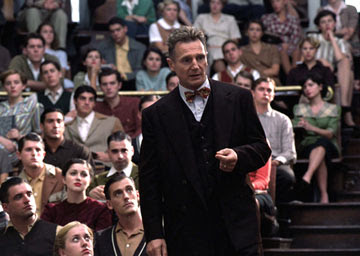
In the case of Alfred Kinsey, though, talking about it was only one step in shattering the walls of taboo that our civilization built around the concept of sexual intercourse throughout the first 50 or 60 years of the 20th century. Looking at it today, what with all the liberated sexual movements dotting our population, the very idea seems absurd. After all, in the middle ages, sex wasn't so much a quandary as it was an casual activity - but with the evolution of cultures and the coming of social status, it was thrown into the corners of a dark room and locked away, never to be spoken of. That the American society in particular treated sex like some kind of illegitimate child well through the modern era is not necessarily something to be proud of, but it was also difficult to step outside of those boundaries, too. Traditions lead to personal ignorance, and that in turn inevitably keeps the traditions established for future generations.
- Tagline from "Kinsey"
In the case of Alfred Kinsey, though, talking about it was only one step in shattering the walls of taboo that our civilization built around the concept of sexual intercourse throughout the first 50 or 60 years of the 20th century. Looking at it today, what with all the liberated sexual movements dotting our population, the very idea seems absurd. After all, in the middle ages, sex wasn't so much a quandary as it was an casual activity - but with the evolution of cultures and the coming of social status, it was thrown into the corners of a dark room and locked away, never to be spoken of. That the American society in particular treated sex like some kind of illegitimate child well through the modern era is not necessarily something to be proud of, but it was also difficult to step outside of those boundaries, too. Traditions lead to personal ignorance, and that in turn inevitably keeps the traditions established for future generations.
Friday, December 31, 2004
Beyond the Sea / *** (2004)
"Beyond the Sea" maintains the same indirect tradition seen earlier this year in "De Lovely," in which a famous talent seems to stand off in the shadows while his memories manifest in the form of a stage musical. In what can essentially be described as a "This is Your Life" technique, audiences are forced to accept the impression that there are no cameras or scripts around dictating the movement of the narrative in front of them - instead, life itself wants to play out unhindered right in front of our eyes, as if the characters are playing puppeteer with their own recollections so that ordinary instances are made into glossy moments without seeming obviously recreated. Make sense? Of course it doesn't, and such an approach was certainly part of the problem with the recent Cole Porter film biography (among other things). The questions are often too great to be skipped over. What reality are these people in? Are they stuck somewhere between consciousness and dream? And how can anyone remember so vividly the fine details of their own past? The immediate dilemma facing Kevin Spacey, who both directs and stars in this biopic about singer Bobby Darin, is that his source material is required to reference the famed celebrity's untimely death. Therefore, if there is demise here, how can a persona plausibly look back at his life after the fact? What is the ground rule, exactly?
Wednesday, December 29, 2004
The Aviator / ***1/2 (2004)
Martin Scorsese's passionate love of filmmaking has no doubt made him an ideal candidate for all sorts of new cinematic challenges, and in "The Aviator" he finds himself at the helm of something particularly interesting: a story that blends familiar narrative territory with a seemingly-foreign historical context (at least to him). It is easy to understand, at least, his primary desire; after all, a good portion of his career has centered on the notion that his film's heroes are usually encumbered by enough quirks and personal dilemmas to undermine their sense of importance. As luck would have it, famed billionaire Howard Hughes was exactly that kind of individual in real life - so much so, in fact, that one almost wonders whether the director's past endeavors were just stepping stones on the way to channeling this specific persona. Drive made Hughes a figure of notoriety, no doubt, but fate brings his visage to the fingers of a craftsman whose own fame is a result of dissecting the most flawed and troublesome movie protagonists of our time. He hardly seems out of place with the familiar approach, but the facet of reality gives him a whole new playing field to explore.
Monday, December 20, 2004
National Treasure / *** (2004)
If you can call it entertaining, you're more than justified in calling it good. This, at least, is how someone like yours truly feels when it comes to "National Treasure," a sleeper hit that has endured so much critical backlash since its release in November that one almost feels guilty in disagreeing with the consensus. The audience, on the other hand, seems to have seen a different film than what the paid professionals have: an action vehicle that on one hand is very silly, and on the other is extremely effective in conveying the sheer thrill of its wacky situations (and judging by the box office success, one would also argue that it's probably worth repeat viewings). For fairness sakes (and for the basic fact that I simply enjoyed what I was seeing), I am obliged to leave all points of cynicism out of this review. Few can argue that John Turteltaub's ambitious vehicle is about as unbelievable as a film can get, but if one is able to leave all sense of logic at the door, it's also very hard not to have a darn good time in the process.
Friday, December 17, 2004
Blade Trinity / ** (2004)
"Blade: Trinity" begins with an effective sequence in which a group vampires revive the spirit of Dracula, and then slowly but surely abandons the franchise hip factor and descends into pure banal territory. One would have hoped that this trilogy would go out with a bang, but the gun winds up shooting blanks instead. And that's more of a shock than you might realize, too, because like its predecessors, the picture is engulfed by a premise so seemingly expert that it would be hard to impair its quality otherwise. The first two movies, on the other hand, knew that it took more than just a heap of action shots to shape an intriguing premise into an equally-satisfying payoff; here, director/writer David S. Goyer seems to be more amused by visual energy and less concerned with how he is going to answer crucial questions or when the plot will be allowed to think instead of react. That Goyer is the same writer of the previous "Blade" flicks as well as the brilliant "Dark City" is an issue that few will be able to get past.
Friday, December 10, 2004
Alexander / *1/2 (2004)
"Fortune favors the bold."
Judging by Oliver Stone's "Alexander," it also favors the pretentious. By far the most impressively inane blockbuster to hit the big screen all year, here is a film that reaches so high and far that it's almost a little perplexing as to why it makes such a miserable thud in the end. For a new filmmaker with dreams of cinematic grandeur, such an undertaking would have died even before the footage was done being shot - but for a filmmaker like Stone, who has both made a career out of strokes of brilliance as well as periods of temporary insanity, the product creates the distinct feeling that it is being delivered just for the sake of silencing impatient investors. The director and his cast and crew of talented individuals did not so much make a movie as they made a mess; it lacks both the shape and the skill of a plausible historical epic, and the fact that its scope is so extensive leaves you feeling like a kid who is being pulled away from all the fun rides at the local carnival.
Wednesday, November 17, 2004
Task of movie reviewing made much easier by absence of Jack Valenti
Just this past week, DVD screening copies of the Focus Features releases "The Door in the Floor" and "Eternal Sunshine of the Spotless Mind" wound up on my doorstep. Their arrivals certainly weren't something to jot down on the out-of-the-ordinary note pad or anything (if you were a member of the Online Film Critics Society, you'd know full well that this happens frequently during the latter months of a year), but considering how much hysteria had been caused in the industry over the previous months regarding piracy, they were nonetheless a sight I hadn't expected to see for some time. The first emotion was that of skepticism, but then an epiphany: "Of course! That old poop Jack Valenti is no longer at the head of the table at the Motion Picture Association of America!" Remember what they used to say in those high school comedies about parents always spoiling the fun of an ambitious teenager? Imagine, then, how a party animal would feel knowing that his mom or dad has gone on an extended vacation, leaving him alone in the house.
Thursday, November 11, 2004
The Polar Express / ** (2004)
"The Polar Express" is the most expensive vanity project ever made. Fashioned out of a computerized concept, with a budget that reportedly extends into the area of $170 million, Robert Zemeckis's flashy and ambitious motion-capture holiday cartoon is so intoxicated by its own wild production values that it has little time to do anything else - not the least of which is tell a halfway-compelling story, even by the average child's standards. And that's a little disheartening, because the picture and all its positive energy arrives at a very convenient time, when the world around us in utter turmoil and there is such a strong desire for something genuinely uplifting. For those a little more intuitive than most young kids, however, it's hard to find much to celebrate in a film that seems less like a good-hearted fable and more like a successful business man waving around his bulky check book.
Friday, November 5, 2004
I, Robot / ** (2004)
Seeing the name Alex Proyas attached to any science fiction film should be an immediate assurance of greatness. What we are dealing with here is not just a specialist of his craft, but an artist and a visionary, celebrated by his peers for taking minimal concepts and developing them into something beyond expectation. Any moviegoer who was fortunate enough to get to see his "Dark City" during its brief 1998 theatrical run can vouch for this claim, as it remains perhaps the most imperative film of its genre in the last ten years (and more importantly, was seemingly responsible for providing a lot of the early ideas explored by the Wachowski brothers in "The Matrix"). Now, the very suggestion of seeing him at the helm of "I, Robot," a film inspired by the famous Isaac Asimov story of the same name, suggests that we may be in for a repeat scenario. Once a guy finds his true forte, after all, what's to stop him from going even further?
Shark Tale / ** (2004)
Ocean divers see only what their eyes permit when they descend into the deep corners of the sea, but animators come equipped with the privilege of imagination which allows them to perceive such things in both a brighter and more amusing framework. Innocent schools of fish can become civilized societies, while vibrant coral reefs can become big urban habitats. The fact that the floodgates have opened thanks to computer animation now allows these images to be pure realities - but just as innovation can breed creativity, so can it too breed repetition. Disney/Pixar's "Finding Nemo," released last year to immense commercial success, was the first computer-generated endeavor that gave personality and narrative flair to deep-sea creatures, and now we have "Shark Tale," in which the filmmakers fill the screen with the same familiar backdrops and characterizations that seem to have grown all too common by animation standards. If not for the fact that the visuals remain so colorful and distinctive, in fact, one would almost accuse the studio, Dreamworks, of being too predictable a competitor.
Saw / **1/2 (2004)
Unconventional brilliance or over-the-top fodder? These are the two answers that come to mind when one questions the achievement that is "Saw," especially as it leaps ever-so-zealously towards an ambitious climax. Up to that point, the movie's near-numbing attack on the senses has a certain zeal that is almost commendable - its approach a drastic departure from the most recent Hollywood horror films - and viewers react, just as the filmmakers hope, with a certain distress that is almost emotionally scar-inducing. But as is required of any movie with the chutzpah to challenge the conventions of value in the cinema, there must also be a certain amount of relevance in the scenario so that it emerges as something more than just a flashy geek show. Director James Wan's serial killer thriller, about a murderer whose streak of homicides makes his victims the target of their own fate, seems to provide little ground for that to happen; while its details are hardcore and gratuitous, the payoff is lackluster, and nearly all the moments in which you expect the film to pull away the mask and reveal a deeper identity end up feeling like long exercises in overkill. The fact that it is all well made on a technical level makes that assertion all the more difficult to face.
The Incredibles / **** (2004)
Pixar's "The Incredibles" is by far the best of the CGI-animated films in the Disney canon, a wondrous and exciting spectacle that is just as enticing narratively as it is visually, and a film that reaffirms the strength of the animator's imagination. It's also a considerably extreme departure from the Pixar standard, side-stepping the widely-accepted "buddy movie" approach of films like "Finding Nemo" and "Toy Story" so that it can charter new and more satirical territory - namely, a story involving a family of misfit superheroes. The leader of the pack, Mr. Incredible, is kind of like a Superman with more compatible social skills, and his partner in crime, the virtuous and fetching Elastigirl, is a headstrong woman who is perfectly capable of holding her own against a job dominated by the male ego. Together, they live by the tasks of any standard superhero formula - save the world, try to live a "normal" life, then save the world all over again - but as the movie opens, their vocation of choice is suddenly undermined by the onslaught of countless frivolous lawsuits (in one instance, Mr. Incredible saves a suicidal man but winds up injuring him in the process, thus resulting in a legal battle). With the profession now threatened, heroes worldwide turn in their masks and enroll in the Superhero Relocation Program. Their days of saving lives and correcting misdeeds, it seems, are over.
Thursday, September 30, 2004
Alien vs. Predator / * (2004)
The creature in John McTiernan's "Predator" was a hunter for sport, preying on anything and anyone with the chutzpah to put up a commendable fight, but to see "Alien vs. Predator" tell it, they were also revered as Gods by ancient Earth civilizations, and were directly responsible for teaching our ancestors how to build great structures like the pyramids. Quite remarkable, if you think about it - in one fell swoop, a screenplay not only manages to build back-story on a famous movie villain, but also solve one of the biggest mysteries of our planet's historical past. If you think that's amazing, then just imagine the surprise of several of the movie's characters, who are recruited at the beginning of the film to be the first men and women to explore the ruins of a newly-discovered multi-cultural pyramid buried beneath hundreds of feet of ice in Antarctica. Some are ecstatic, others are bewildered; but none of them, needless to say, are aware that this hidden fortress is actually an active hunting ground for the Predators themselves, who revive it every hundred years and engage in a dangerous cat-and-mouse game with humans as the puppets. How fortunate for the film to make this great discovery just as the fortress is being revived for another round of bloodshed.
Friday, September 10, 2004
Cellular / ***1/2 (2004)
Colin Farrell discovered last year in "Phone Booth" that Alexander Graham Bell's nifty little invention could be just as much a weapon in daily life as it can be a communication asset. Now comes "Cellular," in which Chris Evans plays a beach-going guy named Ryan, who answers his cell-phone and meets a woman on the other end who is in quite a predicament: she is a victim of abduction. As the recipient to this bizarre incoming call, he is naturally skeptical and contends that a practical joke is being played on him. But poor distressed Jessica (Kim Basinger) insists otherwise, going so far as to explain that her contacting a total stranger instead of law officials comes down to the fact that her only line of communication is a busted telephone with no dialing pad. The explanations are a nice touch, but not until Ryan actually hears a direct threat against her life does he finally accept the situation as legitimate. And by that point, of course, he is already so involved in the conflict that he can't simply hand it off to some random law official. Here, the cellular phone is not simply a device that assists this unlikely hero in undertaking whatever tasks are required of him; it is the one thread of hope of keeping this woman (and maybe even her whole family) alive.
Tuesday, August 31, 2004
Exorcist: The Beginning / *** (2004)
It's difficult to approach certain movies without the smallest morsel of cynicism, especially when they are undertakings with as convoluted a past as "Exorcist: The Beginning." Practically any movie news site would be happy to report that this theatrical release is actually the second complete version of a prequel to William Friedkin's immortal 1973 scare-fest, assembled from scratch by director Renny Harlin after the studio's first cut (directed by art-house filmmaker Paul Schrader) apparently wasn't even scary enough to be re-edited from scrap footage, let alone deserve a release. What Morgan Creek might not have consciously realized at the time, however, is that their decision to completely redo an existing and unreleased film was something for the cinematic history books, a resolution so excessive and tricky that it represents a case of decision-making that is simply unprecedented in its extremity. Furthermore, to simply erase one man's entire effort and replace it with another's also meant that a second film based on one premise would be a big gamble financially; unless it set box office charts on fire, the studio would actually be coping with the loss of money from not one but two films. That's good decision-making for you, I guess.
Saturday, July 31, 2004
The Village / *1/2 (2004)
For what seems like generations in M. Night Shyamalan's "The Village," a peaceful establishment of villagers has lived in complete seclusion, fearful of the idea of venturing out of their own borders and into the forests where unknown beings lurk. Their worry of the outside is underscored early on as farmers and young children feast at tables on an open meadow, and a beastly cry in the wooded hills echoes across the landscape, sending chills up and down their spines like mice waiting for a ravenous cat to pounce. No one knows exactly who they are or what they look like, but the town's elders refers to them as "those whom we do not speak of," suggesting that the outside forces may range from barbaric humans to bloodthirsty monsters. We as audience members know even less than what the characters seem to, but we share in their sense of dread; a world in which the boundaries are determined by lit torches and guard towers, after all, doesn't suggest that the outside beings are that peaceful or civilized.
Subscribe to:
Posts (Atom)


