The reveal of a new chapter in the elaborate "Star Wars" saga may seem commonplace in an age when special effects have been able to discover countless visionary movie worlds, but it is important to remember that the essence of our movie blockbusters today is partially owed to the ambition that set this franchise into motion all those years ago. When the first part of this story was unleashed in the mid-70s, it did more than just excite and marvel those who witnessed the spectacle; it literally awakened a new generation of dreamers, who saw cinema as more than just a tool for mimicking the foreground of our everyday lives. Here, at long last, movies were capable of exploring the universes that were nothing more than just figments in one's imagination on a grand scale. Limits were breached, walls were torn down, and gravity was eradicated from celluloid forever. Not a single person who saw the film could challenge its scope or its animal enthusiasm, and its legacy, further enriched by two equally satisfying follow-up chapters in the forthcoming years, was one that not only endured for future generations but in ways stayed relevant even amongst a slew of equally-ambitious endeavors that filled the theaters in the decades to come.
Thursday, May 19, 2005
Tuesday, May 10, 2005
Kingdom of Heaven / ** (2005)
Ridley Scott's latest excursion into the eras of old, a religious war epic called "Kingdom of Heaven," opens with a scene in which Godfrey (Liam Neeson), a knight from Jerusalem, returns to his home in France to reunite with the son he never knew. Young and quiet Balian (Orlando Bloom), on the other hand, doesn't seem very anxious for any kind of family reunion; recently scarred by the death of his newborn child and suicide of his wife, he passes days in a remote village making horseshoes and saying only what passers by require of him - usually nothing of significance. Godfrey's abrupt arrival might have at least seemed startling to such a hardened mourner, but for Balian it's just another revelation in a series of days he wants to be long over. Even when he accepts an offer from his new-found father to escape France and return to the Christian-ruled holy land, we never sense that he is doing it for the sake of understanding his father's desertion or for getting to know him in any capacity. At that stage in his life, the only thing that matters to him is change, and running away from the tragedies of his wife and child turns out to be motivation enough.
Friday, May 6, 2005
House of Wax / zero stars (2005)
"House of Wax" is such a vile and despicable heap of trash that I pity any lucid person who will actually pay decent money to sit through it. As a straight horror film, it supplies no legitimate horror other than the notion of sabotaging its source material in favor of visual repugnance, and as a remake of yet another famous 1950s scare-fest it completely squanders any chances it might have had of at least being amusing on the nostalgia scale. The people involved in making this thing should be ashamed of themselves; it is the kind of picture so revolting that it deserves to not only undermine careers but general reputation as well. A good manager might have pointed out that such a credit on a film resume might do a lot more damage than it's worth, but I guess you can't necessarily expect much sense from anyone who showed interest in the project to begin with.
Thursday, May 5, 2005
The Hitchhiker's Guide to the Galaxy / *** (2005)
The mentality of the average moviegoer is not one that is very receptive towards products that demand you to step into an alternate medium in order to acquire necessary background knowledge. This will surely be the primary dilemma facing many a casual viewer upon witnessing "The Hitchhiker's Guide to the Galaxy," the new film adaptation of the famous 1970s series of sci-fi comedy novels. Penned by a quirky and spontaneous over-achiever named Douglas Adams, the material is, I gather, a lot more detailed and informative than what the cinematic translation is willing to provide - here we get countless quips, quirks and moments of ingenuity that seem like they are referencing something much greater than what actually plays out. The narrative structure is painted in extremely broad strokes, occasionally punctuated by something satisfying, and most of the inevitable laughs come not from the fact that there's an effective punchline, but just for the fact that they are spontaneous and fall at an amusingly random pace.
Friday, April 22, 2005
The Amityville Horror / * (2005)
When the most fascinating character in a movie comes in the form of an old haunted house, you are either dealing with something very precarious, or very stupid. Bearing in mind the source of the new remake of "The Amityville Horror," it is wise to consider the latter. Derived from a popular horror film franchise that began in 1979, this dry and stagnant upgrade stays true to its antecedent in one explicit way: by allowing all its core human players to be upstaged by the notion that a physical dwelling looks and sounds like it may be inhabited by an evil presence. Beyond that, director Andrew Douglas takes an even more unfortunate road: he remains so close to the atmosphere and conflict of the original that you feel like you're looking at nothing more than a bunch of nothingness sketched out on tracing paper. The original "Amityville" feature was by no means a treasure of cinema to begin with, and such a notion makes it even more painful to sit through this time around. The remake does absolutely nothing to modify or improve upon its predecessor, which makes it completely pointless.
Friday, April 1, 2005
Sin City / **** (2005)
The metropolis at the heart of "Sin City" is a sensuous haven of mass corruption and peril, its foundations rooted in the innocent blood that is spilled across miles of murky terrain. Characters rise from a cesspit of cruelty and ascend even more dangerous ladders; they taunt, tantalize and manipulate each other like criminals without higher authority, and their moral convictions are seldom about sensibility as much as they are about foolish and wanton desires. But experience in the shadows has nonetheless made them survivors, and when the intensity of their quick-witted instinct kicks into high gear, narrative conflicts become platforms for all sorts of social and political intrigue. Many of the city's more determined citizens also take great pride in sharing their personal insights with the audience - via sober voice-overs, they obsess over details, persuade with colorful analogies ("He had the wrong luck of being born in the wrong century."), and shamelessly blur the lines on what constitutes right from wrong. In a place as merciless as Basin City, however, endurance comes down to not just stealth or wisdom, but the demand to see only in terms of black and white. There is no middle ground to tread here, just one extreme after another. And there comes a point when you suspect everyone involved likes it that way, too.
Tuesday, March 22, 2005
The Ring Two / *1/2 (2005)
"The Ring Two" isn't so much a sequel to "The Ring" as it is a full-fledged re-analysis of that successful 2002 horror film. This, suffice it to say, is not a compliment. The fundamental flaw essentially comes down to the approach - instead of carrying the pre-established narrative into newer and more challenging territory, as a legitimate sequel might have done, the movie seems more motivated by explanations of past events here rather than developing on them, and the celluloid is filled with so much incessant narrative double-speak that it essentially makes the original story more convoluted than it already was.
Monday, March 14, 2005
Robots / ***1/2 (2005)
With the onslaught of offbeat cartoon casts dominating computer animation, it's just as well that the filmmakers behind "Robots" opted to take a more broad approach by relying on an ensemble of talking machines. Such things aren't shackled by physical delicacy like fish or bugs are, nor do they live by the seeming elasticity of superheroes or toys. But they move, talk and interact without the kind of restraints expected of their counterparts; they have human qualities but rise above their manacles, and occupy a space of the universe that seems just as complex and surreal as the very essence of their own intricate being. Of course, cinema's ongoing fascination with all things machinery - stretching all the way back to a villainous computer mainframe in "2001: A Space Odyssey" - no doubt sets a solid stage of reputation beforehand here, but more promising a prospect is the notion that these types of characters simply seem ideal for the animated canvas. Reality makes them a template for big dreamers, and the gravity-less scope of CGI enhances that prospect into something truly awe-inspiring.
Monday, February 21, 2005
Constantine / ** (2005)
"Constantine" is what you call chaos with skill, a movie in which the production values are top-notch and exude the sheer enthusiasm of a dedicated director, but whose narrative is so inconsistently vague that the audience never has a clue as to what avail they are being utilized. New filmmaker Francis Lawrence, who seems just as much inspired here by the satanic thrillers of Roman Polanski as he is by his own roster of stylish music videos, searches long and hard for the right visual note and finds it - his movie is seeped in a texture that is as polished as one can expect, and he balances it with a stylistic tone that offers good contrast between the foreboding and the hardcore. The bigger mystery lies in knowing what his screenwriters were thinking. What were they motivated by here? Where did all their inspiration go? And did Lawrence ever actually sit down and discuss with them, in any capacity, about where to go with the premise they were given? The result reeks of obvious fragmentation, and one has to wonder if the director was just so excited about the prospect of doing his first feature film that he forgot to cover all the necessary bases beforehand.
Monday, February 7, 2005
Hide and Seek / * (2005)
"Hide and Seek" is the kind of movie that gets made when a filmmaker thinks he or she has come up with a unique narrative ploy to exercise on audiences, an endeavor so wrapped up in flinging around ambiguous insight and suggestion that it more or less directs itself, seemingly convinced that there is enough foundation there to warrant a unique payoff. Alas, anyone who has seen more than two or three thrillers in the recent years could easily crush the confidence shared by these filmmakers; not only do the director and writer fail to recognize obvious formula, but they also fall short of providing it with the right guidance to at least hold one's basic interest. Their picture is a self-indulgent mess; unexciting, shoddy, predicable, tedious and detached, and frankly not all that amusing even on a level of mindless escapism.
Saturday, January 29, 2005
The reputation of being a "film critic"
It's always a nice gesture when someone takes the time to read a piece of your written work. There is also a great personal reward in having that work discussed between the writer and the reader; not only does it make you more productive in terms of understanding one another's opinions, it keeps you motivated and focused in the task of producing new articles, particularly when you have the urge to stand back and wonder, "why am I doing this at all?"
In the six-plus years I have written film commentary on the internet, I've heard great input from a lot of sources -- some of it positive, some of it negative, but all of it appreciated. There is no better feeling in this vocation than knowing that your work is being absorbed by some alternate source; you have done something that will occupy a span of a few minutes in someone's day, and perhaps will leave a slight impression (be it a bad one or whatever). In our world time is the essence of everything, after all, and sometimes it is actually too much to ask for people to set aside just a few short moments to take a look at something you've done. By doing so voluntarily, the readers have unknowingly made a great contribution to the one who actually did the work (regardless of the response they may have). It is prospects like that which keep some of us writing for so long.
Friday, January 28, 2005
In Good Company / *** (2005)
"In Good Company" begins with a premise that is probably not very dissimilar from what many of us in the world of journalism have experienced at one point or another. Dan Foreman (Dennis Quaid), a reputable advertising editor at the local weekly Sports Magazine, is put into a position of uncertainty when his chain is bought up by a major conglomerate, and established employees begin facing possible lay-offs as the company undergoes major restructuring. Perhaps not so common, though, is how this professional shake-up plays out; rather than being ousted by a corporation that wants to abandon journalistic rituals in order to stroke investors, the movie deprives him of his high-ranking position and turns it over to a 20-something kid, who is a hot figure in the business world but lacks the experience to be in such a place of authority. Naturally, Dan is kept on board as a cushion while all his friends are ousted… but the story doesn't directly confront this conflict until its hero finds out that his new boss is also dating his college-bound daughter. Talk about getting to know your employees better.
Wednesday, January 12, 2005
Stage Beauty / **** (2004)
To see "Stage Beauty" in its full lively splendor is to see a work of genius revealed on screen. The movie is savage entertainment, written with the kind of panache and wit that is generally absent in most modern period pieces, and executed in a manner that allows little room for mere suggestion but an array of opportunities to be both shocking and unrestrictive with the material. From the perspective of someone who, like yours truly, savors the deliciousness of stories that take place amidst a vibrant and colorful backdrop, it is a triumph of evoking the era - but for those who care less about visuals and concentrate solely on a narrative, it is also one of those rare multi-faceted accomplishments that knows no boundaries when it comes to solid storytelling or sophisticated humor. Like the very characters that fill the celluloid of director Richard Eyre's latest opus, this is the kind of picture that comes with challenges but is not afraid to meet them - or indeed, overcome them - head on.
Friday, January 7, 2005
White Noise / * (2005)
He or she who is able to emerge from "White Noise" with a full perspective on the plot should be regarded as a miracle worker. Here I am, a movie critic writing a review for a movie that I observed with the utmost attention for a full 100 minutes, and I can't even bring myself to come up with the words to describe it - other than saying it wants to be both scary and stimulating. Of course, being an endeavor that lacks any kind of solid framework, it fails miserably on both counts. There is certainly very little doubt that someone, somewhere, high up in the Universal Pictures chain of command saw a promising result from this sort of premise… but what in the world are the filmmakers trying to say with it here? How do they expect their movie to amuse or engage viewers in the slightest if it doesn't take the time to offer necessary insights into enigmatic clues and puzzles?
Kinsey / ***1/2 (2004)
"Let's Talk About Sex."
- Tagline from "Kinsey"
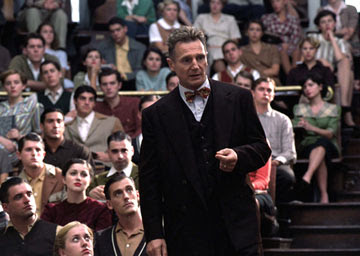
In the case of Alfred Kinsey, though, talking about it was only one step in shattering the walls of taboo that our civilization built around the concept of sexual intercourse throughout the first 50 or 60 years of the 20th century. Looking at it today, what with all the liberated sexual movements dotting our population, the very idea seems absurd. After all, in the middle ages, sex wasn't so much a quandary as it was an casual activity - but with the evolution of cultures and the coming of social status, it was thrown into the corners of a dark room and locked away, never to be spoken of. That the American society in particular treated sex like some kind of illegitimate child well through the modern era is not necessarily something to be proud of, but it was also difficult to step outside of those boundaries, too. Traditions lead to personal ignorance, and that in turn inevitably keeps the traditions established for future generations.
- Tagline from "Kinsey"
In the case of Alfred Kinsey, though, talking about it was only one step in shattering the walls of taboo that our civilization built around the concept of sexual intercourse throughout the first 50 or 60 years of the 20th century. Looking at it today, what with all the liberated sexual movements dotting our population, the very idea seems absurd. After all, in the middle ages, sex wasn't so much a quandary as it was an casual activity - but with the evolution of cultures and the coming of social status, it was thrown into the corners of a dark room and locked away, never to be spoken of. That the American society in particular treated sex like some kind of illegitimate child well through the modern era is not necessarily something to be proud of, but it was also difficult to step outside of those boundaries, too. Traditions lead to personal ignorance, and that in turn inevitably keeps the traditions established for future generations.
Subscribe to:
Posts (Atom)


.jpg)


