Small-town America has proven to be one of the easiest targets for comedic exploits in the movie industry, and no wonder: the idea that an isolated, close-knit community occupied by people who know the names and affairs of nearly everyone else in town could be turned upside-down by scandal, commercialism or similar issues, seems to open up the floodgate for enormous potential. The principal merit in such an endeavor is not usually the plot itself, however, but the colorful characters involved, who tend to be portrayed by the most unlikely actors and are generally conceived with bizarre identities and questionable personal values in mind. Need examples? Think for a moment about the quirky ensembles of "Fargo" and "Mumford."
Friday, January 12, 2001
Friday, January 5, 2001
Tigerland / ***1/2 (2000)
The war depicted in Joel Schumacher's "Tigerland" is fought not on the battlefields, but on the turf of a Louisiana-based instruction camp between several soldiers-in-training, whose fears of a seemingly ill-fated future fill them with anxiety strong enough to warrant sudden outbursts. Just the mere mention of Vietnam sends chills down their spines; perhaps the only thing preventing them from collapsing on the spot is the U.S. army's long-established incentive to fight for your country no matter how severe the situation is. In ways, this may be a precise reflection of the atmosphere that surrounded all the real American soldiers on their way to Vietnam in the 1960s. The only question that remains: was it all necessary?
Requiem for a Dream / ***1/2 (2000)
It can be said that an addiction to drugs is like hiking in circles, because no matter where that person begins, the path that follows leads nowhere but directly back to the one position where it all first began. Sooner or later, addicts will have to reconfront the exact issues that initially spurred those addictions: money problems, curiosity, escapism from a crumbling life, and so on. Seldom is something meaningful ever gained in the process, needless to say; although there are moments when the drugs seemingly suspend all rules and set them free, the aftermath deals out a heavy share of damage, both psychological and physical. The extent of the damage all depends on the length of time such a dependency lasts.
Friday, December 22, 2000
The Contender / **** (2000)
The term "dirty politics" is viewed under a loose definition because of the several ways it can be practiced in government, but Rod Lurie's "The Contender" casts an argument that is not only the most familiar, but perhaps also the most serious and defaming. Reflect back on the scandal that put President Bill Clinton in hot water with Congress: indeed it seems that the ideal approach in discrediting any politician's reputation is to go searching for some dirt of a sexual nature. What most utilizers of dirty politics do not always realize, however, is that leaking such information on someone's past may actually improve an image rather than tarnish it, simply because the general public accepts the fact that politicians are humans themselves, and in some cases should not always be held up to higher moral standards than those of any regular US citizen. Imagine Kenneth Starr's reaction, for instance, when the details of the Clinton sex scandal became public knowledge, and the president's approval rating skyrocketed as a result.
Dancer in the Dark / ***1/2 (2000)
So traumatic is the emotional charge established in "Dance In The Dark" that it will likely leave many of its viewers paralyzed with distress for days afterwards. With that kind of profound aftertaste comes the question of whether we as the viewers will be able to ultimately stomach the significant pain and suffering that the movie throws at us, especially judging from the mixed reception that the picture has received already. While several critics have hailed it as one of the year's crowning achievements, others have denounced it as an exercise in nihilism, without relief or constraint from the presence of a largely depressing atmosphere.
The Sixth Day / *** (2000)
Science has made broad leaps in allowing humans to do what they want to the Earth and its resources, but nothing quite as powerful as the process of cloning living organisms. We've read in newspapers and seen on television of how it is now possible for scientists to actually clone adult sheep, practically duplicating them without any fanfare or elaborate experimentation. But the process, needless to say, has been attacked even before it was technically possible, mostly by people who are concerned that mankind may be digging its own grave by practicing things it has no right to do. Now the concerns grow thicker day by day, as scientists ever-so-steadily creep towards the moment when they are able to successfully duplicate an actual human.
Vertical Limit / *** (2000)
The art of rock climbing is one of the most demanding and treacherous undertakings available to us as adventurers, in which every obstacle, every sound and every movement is an innuendo to a clouded outcome. Even the world's most experienced mountain daredevils are at high risk of losing their lives; every year, countless rock climbers tread the slopes of steep mountains with treacherous inclines, and never live long enough to tell of their nail-biting experiences. And yet why do we, year after year, continue to scale the world's great rock giants like Mt. Everest, taking the risk of putting a halt to our own existence? The challenge of something that is seemingly hopeless to conquer fills us with the adrenaline and audacity of a large fantasy warrior who keeps swinging his sword, but may never have the power to ultimately take down the dragon.
Friday, December 15, 2000
Charlie's Angels / * (2000)

If there were really movie curses, one might say that such a thing has befallen the "TV-to-movie" genre in the past decade. For some vague, unexplained reason or another, motion pictures that attempt to use popular television shows as source material suffer from bad cases of tone-deafness, underwritten plots, scarce character development, and a variety of other things. And yet excuses seem irrelevant; if a film has already established its plot and characters from something that existed farther back, doesn't that at least leave room for filmmakers to build on those grounds with something worthy of cinematic status?
Meet the Parents / ***1/2 (2000)
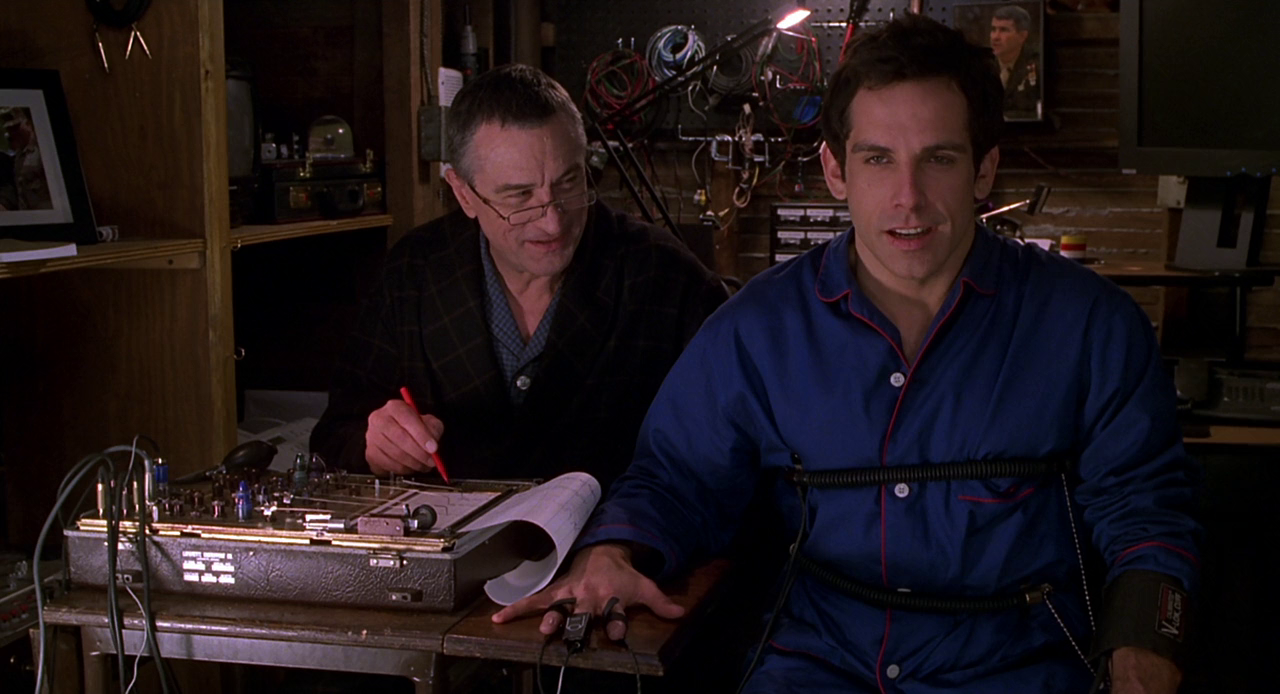
Imagining "Meet The Parents" without the brilliantly enticing comedy antics of Ben Stiller is like picturing "Aladdin" without the Robin Williams Genie. He's not just the funniest part of the picture; he's the backbone as well. Those who are solely concerned with the presence of actor Robert De Niro might be a little bewildered with that proclamation; after all, the latter has so much more potential on screen, especially in comedies (even though his two most recent, "The Adventures Of Rocky And Bullwinkle" and "Analyze This," are shameful trash). And yet this is not a big surprise by any standard, because in the recent years, we as moviegoers have seen Stiller thrive under the influence of bad taste, embarrassment, satire and physical comedy as if he were made for it. Case in point, the man may actually deserve comparisons to the greater comedians of cinema's past.
Red Planet / ** (2000)
Movie blockbusters appear to be trapped in an endless, disheartening cycle in which almost every concept is often materialized in pairs, with both productions usually being released so close in time that a nagging sense of deja vu is usually present by the second time around. Evidence to support this has been too numerous to maintain, but among the chief examples of this are the concepts of volcanic disaster ("Dante's Peak" and "Volcano"), asteroids or meteors ("Deep Impact" and "Armageddon"), gooey creature features ("Phantoms" and "Deep Rising"), and most recently, perilous ventures against the forces of nature ("The Perfect Storm" and "Vertical Limit"). One notable but wasted concept under this rule is that of Mars exploration, in which ambitious filmmakers have foreseen mankind finally placing feet on the sand of that elusive red planet, then realizing just how complicated the matter can turn in to. The first film under this idea was released in early 2000 under the name of "Mission To Mars," which was directed by Brian DePalma and featured an ensemble cast that had the ferocity and willpower of your average football team. Now comes "Red Planet," which is being unleashed on a cinema where most members of the audience will likely be asking themselves, "is there really room for another film centered on the idea of Mars exploration?"
Remember the Titans / *** (2000)
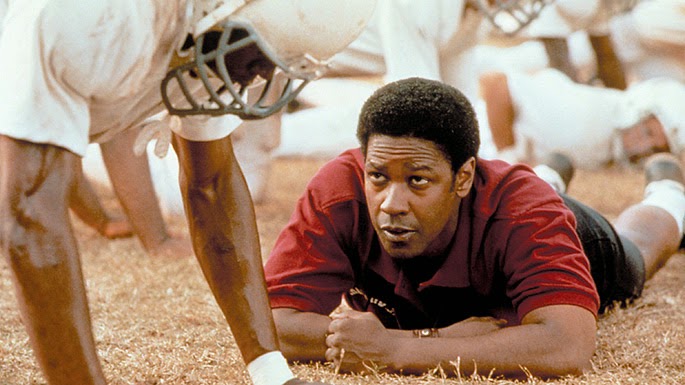
In Greek mythology, the Titans were a band of gods known loosely as "the strivers," who fought a long and hard war against their father, Uranus, before ultimately ending his life and assuming leadership of the free world. Imagine those gods dwelling in today's society, and the result would likely be something along the lines of the high school football team documented in Boaz Yakin's "Remember The Titans." In the year 1971, two high schools in Alexandria, Virginia, separated by their racial status, were merged into one, much to the protest of countless townsfolk who, at that time, believed racial mixing in the public domain was discouraging and unnecessary.
Unbreakable / * (2000)
There is perhaps nothing more pathetic than a movie that supersedes great expression with great contrivance, and M. Night Shyamalan's new thriller "Unbreakable" operates under such reasoning. When dealing with subject matter that borders between realistic and far-fetched, it's not a matter of how the story is set up or what the subject matter deals with: it's all in how you allow it to unfold which ultimately decides the merit. A movie that I am instantly reminded of, "Being John Malkovich," operates on a plain of existence where the inarguable absurdity is effective because of the influence of brilliant satire, strong details, and smart but wicked characterizations. "Unbreakable," like a cinematic opposite, is a long and odd marriage of fantasy and realism, but one that lacks substantial pace, decent characters, thrills, clarity, shape, and its own inspiration too often to ever be taken seriously.
Friday, December 8, 2000
The Art of Amalia / *** (2000)
Behind every great voice in music is a marvelous force possessing it, and "The Art Of Amália," a documentary from Bruno de Almeida, acquaints us with a pair that will never be forgotten… unless you are from the United States. Readers from other countries will have undoubtedly already heard her name by now; elsewhere, Amália Rodriguez, whose astonishing and successful career lasted for 60 years, is already seen as a legend among peers.
She was a Portuguese singer born into a low-class neighborhood of Lisbon in 1920, and at age four was already being asked to sing for the neighbors. In 1939 she began a career as a nightclub singer, captivating audiences with a seductive voice that melted even the coldest hearts, and into the 1940s a recording and movie career were already beginning to take shape. On home turf, her records and movies broke several records, while abroad, listeners slowly started catching on to the depth of her alluring persona.
Bram Stoker's Dracula / **** (1992)
The movie vampire may be one of the oldest living screen creations, but it is also one of the few that has transcended time and formula, evolving with every new generation, always showing up to the cinema well-dressed, established, and heedful of its own deserved existence. It was born on the colorless German cameras of F.W. Murnau's classic silent "Nosferatu," and is once again being revived at the close of this year for Wes Craven's "Dracula 2000." What explains our constant admiration and positive outlook on its illustrious screen career? Perhaps the fact that the sharp-fanged creature is held to higher office than that of his distant cousins—in other words, is more intelligent, more thought-provoking, and most importantly, more realistic than other movie creatures, who have admittedly died out because of their repetitive (but probably ironclad) depiction's. We would normally expect a werewolf or mummy to do in movies the same traditional things, but the vampire has the bearings to take us by surprise, often taking action and choosing victims with unprecedented comfort. Embracing its existence has, needless to say, given it all the more reason to return again and again to the theater screen. We have spurred the bloodsucker's ego, you might say.
Get Carter / **1/2 (2000)
Remember that little running gag in the “Lethal Weapon” pictures where Danny Glover takes a deep breath after a physical stunt and announces that “he’s getting too old for this?” Perhaps Sylvester Stallone could take a study course on it. The now middle-aged but still-beefed up action star makes his anticipated return to the big screen from a three-year absence in “Get Carter,” with what one might assume is a departure role from his “Rambo”/“Rocky” days, but is actually no more than the routine, stamina-driven muscle man he has played throughout his career. The only significant difference this time around (other than the newly sophisticated wardrobe) is that the audience may have finally come to the realization of how tired and generic all of this really is. Stallone is a gifted actor in some aspects, no doubt, but is it possible to continuously take the same playing field without ever collapsing from exhaustion?
Subscribe to:
Posts (Atom)